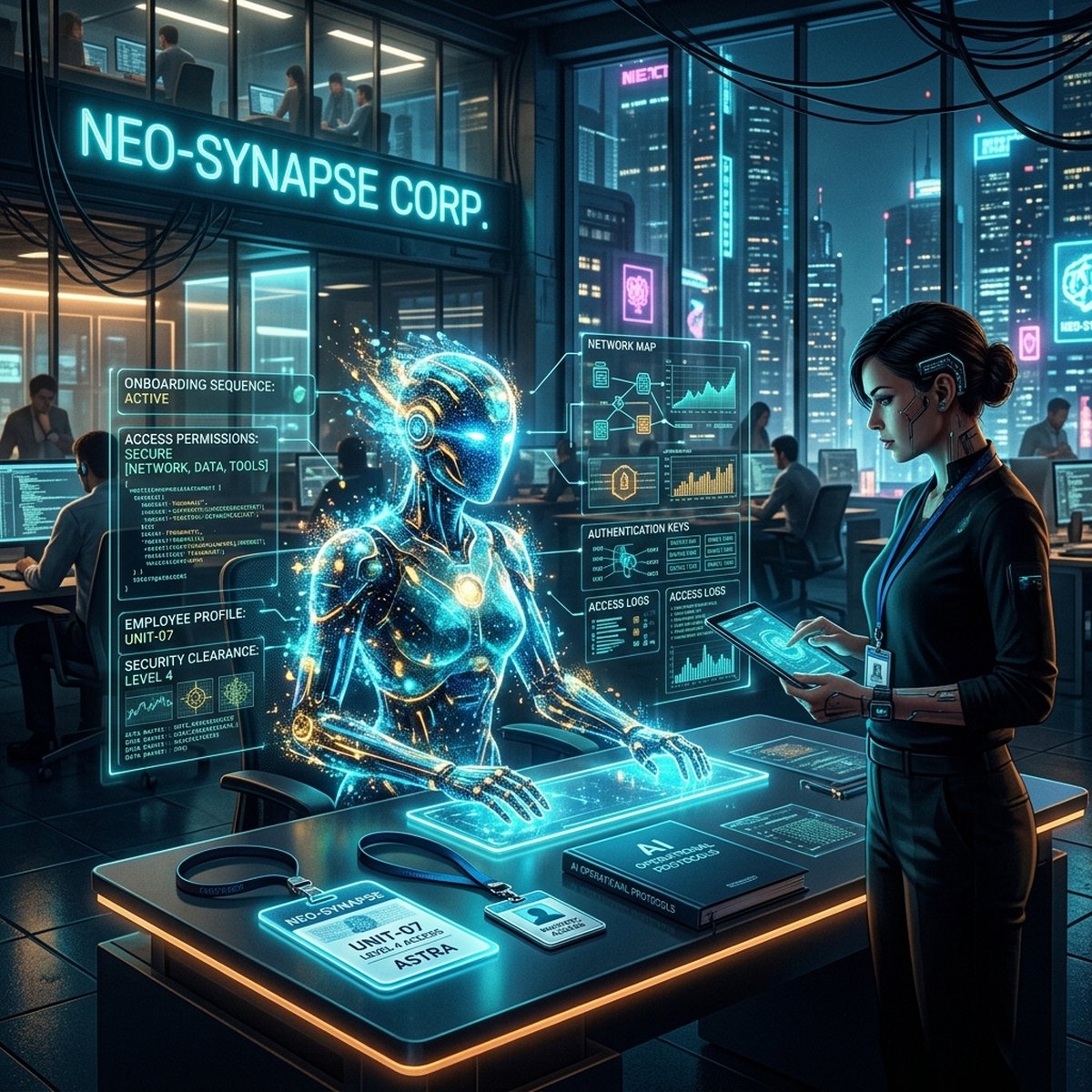
**The AI Agent Has Become an Employee — Now Companies Need an HR Department for Machines**
The AI Agent Has Become an Employee — Now Companies Need an HR Department for Machines
The modern corporate employee has a defined lifecycle. They are interviewed, hired, and onboarded. They are assigned an email address, a Slack account, and access to Salesforce or GitHub. They are given a job description, key performance indicators, and an organizational chart mapping out exactly who they report to and who reports to them. If they exceed their mandate, they are reprimanded. If they steal company data, they are fired and potentially prosecuted.
For fifty years, the enterprise security perimeter was defined by this human identity. Today, that paradigm is shattering.
The enterprise is undergoing a fundamental shift, moving rapidly from artificial intelligence software that merely assists human employees to autonomous AI systems—agents—that perform complex work entirely on their own. These agents are negotiating contracts, auditing codebases, generating financial reports, and resolving customer service tickets with zero human intervention. They are no longer just tools; they are a new class of synthetic labor. And just like human employees, they need an HR department.
The Rise of the Synthetic Workforce
To understand the magnitude of this shift, one must look at where venture capital and enterprise engineering are simultaneously colliding. Software is no longer a passive entity waiting for a human click. The modern AI agent is autonomous, goal-oriented, and persistent.
When a company deplps a customer service agent, that agent doesn't just read scripts. It connects to the company's central database, queries a customer's purchase history, accesses the inventory management system to check replacement stock, and issues a refund via a financial gateway. To do this, the agent must hold credentials. It must be granted permissions. It operates across multiple SaaS applications, navigating the same digital corridors that a human employee would.
This creates a terrifying reality for Chief Information Security Officers (CISOs). A human employee might fall for a phishing scam, but a human employee is also bound by human limitations—they sleep, they take breaks, they can only exfiltrate so much data at a time. An AI agent, compromised or improperly configured, can execute thousands of unauthorized actions per second. It can siphon databases, alter financial records, or leak proprietary source code before a human supervisor even finishes their morning coffee.
The problem is no longer about securing the human. The problem is securing the machine.
Reco and the $55 Million Bet on Machine Governance
The financial markets are already pricing in this monumental shift. Recently, cybersecurity firm Reco announced a $55 million financing round, a massive injection of capital that is particularly revealing of the industry's trajectory. Reco’s platform doesn't just look for malware or bad actors; it maps the intricate web of relationships between AI agents, SaaS applications, human employees, accounts, and permissions.
Why is this necessary? Because the enterprise environment has become a sprawling, untamed frontier of machine-to-machine interactions. An AI agent might be authorized by the marketing department to draft emails, but what happens if that agent inadvertently gains access to the HR database? Who authorized the agent? Who is monitoring its digital footprint? Who is accountable if it hallucinates a damaging email and sends it to a million customers?
Reco's approach highlights the critical realization dawning on Silicon Valley: an agent increasingly needs the exact same bureaucratic infrastructure as a human employee. The enterprise security perimeter is expanding from human identities to machine identities.
The Four Pillars of Machine HR
This realization is birthing an entirely new corporate infrastructure category, one that can be thought of as "Machine HR" or Machine Workforce Governance. This new category is built on four foundational pillars.
1. Machine Identity Before you can manage an agent, you must know it exists. In many enterprises today, agents are deployed ad hoc by disparate teams. Marketing uses one set of generative AI tools, engineering uses another, and finance experiments with a third. This shadow AI is a ticking time bomb. The first step in governance is establishing a universal machine identity. Every autonomous agent must have a unique identifier, a cryptographic passport that authenticates its existence and origin. Just as an employee has an ID badge, the agent must have a verifiable digital signature.
2. Machine Permissions Once an agent is identified, its access must be meticulously defined. The principle of least privilege—a cornerstone of human cybersecurity—must be rigorously applied to machines. An AI agent tasked with analyzing public market data should not have read-access to the CEO's private inbox. The permissions matrix for agents will need to be vastly more dynamic than human permissions. Human roles change slowly; agent functions can be altered with a single prompt update. The system governing these permissions must be capable of real-time, context-aware access control, immediately revoking privileges if the agent deviates from its prescribed baseline behavior.
3. Machine Supervision Human employees have managers. AI agents need supervisors, but human supervision of machines is inherently unscalable. If an agent operates at a thousand times the speed of a human, a human cannot review its actions in real-time. Therefore, machine supervision requires supervisory AI. Companies must deploy "watchdog agents"—specialized, highly constrained AI systems whose sole purpose is to monitor the behavior of worker agents. These watchdogs analyze the telemetry of the worker agents, looking for anomalies, policy violations, or signs of compromise. It is an algorithmic hierarchy, a synthetic middle management layer designed purely for compliance and security.
4. Machine Accountability When an AI agent makes a catastrophic error, who is to blame? Is it the developer who wrote the underlying model? The engineer who deployed the agent? The executive who approved the project? Accountability is the most complex pillar of machine workforce governance. Enterprises must establish clear chains of custody for agent behavior. This involves immutable audit logs—digital black boxes that record every decision, query, and action an agent takes. If an agent executes a trade that loses millions, the enterprise must be able to forensically reconstruct the exact chain of logic and data that led to that outcome. Without accountability, the deployment of autonomous agents is legally and financially reckless.
The End of the Software Era
We are witnessing the end of the software era and the dawn of the synthetic labor era. Traditional software was deterministic; you pushed a button, and it performed a predefined action. AI agents are probabilistic; you give them a goal, and they figure out how to achieve it. This autonomy is their greatest strength and their most profound vulnerability.
The companies that will dominate the next decade will not merely be those that deploy the smartest AI agents. They will be the companies that build the most robust infrastructure to manage, secure, and govern those agents. The HR department of the future will not just consist of human resource professionals managing people; it will include security engineers, AI ethicists, and governance architects managing a sprawling, invisible workforce of intelligent machines.
The transition will be painful. There will be high-profile disasters—agents that hallucinate and destroy corporate value, agents that are hijacked by nation-state actors to cripple infrastructure. But the economic incentives driving the adoption of autonomous agents are too powerful to ignore. The synthetic workforce is here. It is time to build the bureaucracy to manage it.
← Back to OSIRIS Series