**The Great Divergence: How the AI Boom is Fracturing into Intelligence and Infrastructure**
The Great Divergence: How the AI Boom is Fracturing into Intelligence and Infrastructure
In the breathless rush to define the artificial intelligence revolution, a fundamental misconception has taken root in the public consciousness and the financial markets alike. We have been conditioned to view the "AI boom" as a monolith—a single, sprawling industry defined by a frantic race to build the smartest machine. It is a narrative dominated by the titans of technology: OpenAI, Meta, Google, and a handful of heavily capitalized upstarts, all competing to construct the ultimate digital brain.
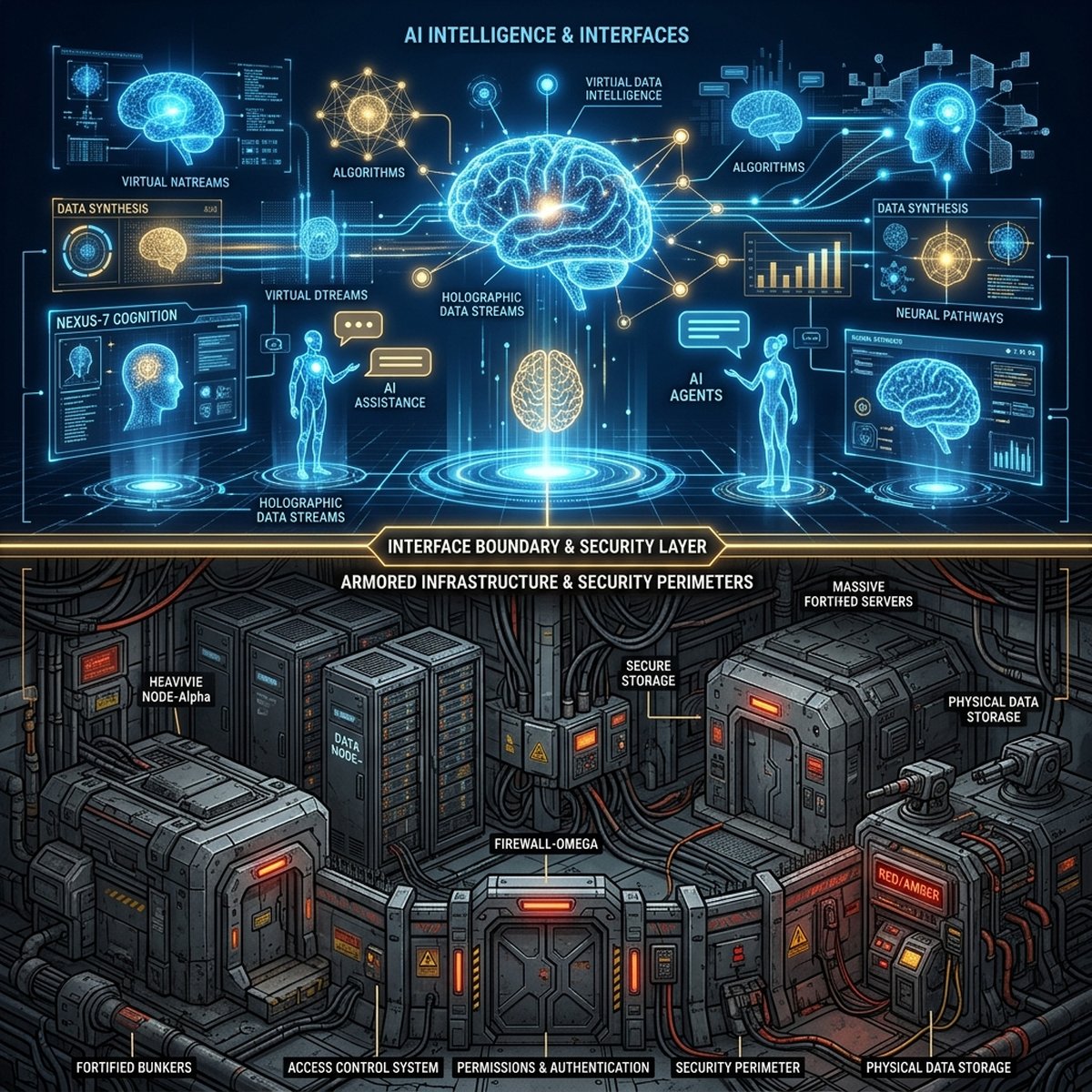
But beneath the surface of this mainstream narrative, a quiet and profound bifurcation is taking place. The AI boom is no longer a single trajectory. It is splitting into two distinct, codependent, and entirely different markets. On one side lies the high-profile race for pure Intelligence. On the other lies a rapidly expanding, largely invisible ecosystem of Infrastructure and Enablement.
This divergence is not merely a subplot in the story of artificial intelligence; it is the central organizing principle of the next decade of technological development. The realization is beginning to dawn on venture capitalists, enterprise architects, and technology strategists: the AI boom is not creating one industry. It is creating an entire industrial ecosystem centered around the deployment, management, and control of machine intelligence. And while the creators of the intelligence are capturing the headlines, it is the builders of the infrastructure who may ultimately capture the lion’s share of the economic value.
Layer 1: The Gods of Intelligence and the Race for Agency
To understand this bifurcation, we must first look at the top layer of the ecosystem. Layer 1 is the market for Intelligence. This is the domain of the foundational models, the large language models (LLMs), and the increasingly sophisticated AI assistants. It is where OpenAI’s GPT-4, Google’s Gemini, and Meta’s Llama models reside.
For the past two years, the competition in Layer 1 has been defined by raw capability. Who can build the model with the most parameters? Who can achieve the highest scores on standardized reasoning benchmarks? Who can process the largest context windows? But that paradigm is already shifting. The frontier of Layer 1 has moved beyond mere conversational capability and into the realm of agency.
The titans of Layer 1 are no longer satisfied with building chatbots that can answer questions or write code. They are racing to build autonomous agents—digital entities capable of understanding a complex goal, breaking it down into a sequence of steps, and executing those steps across various software environments without human intervention. Imagine an AI not just telling you how to book a flight, but navigating the airline website, inputting your preferences, negotiating the price, and using your credit card to finalize the transaction.
This transition from conversational AI to agentic AI is a monumental leap. It transforms the AI from an advisory tool into an active participant in the digital economy. Meta is aggressively pushing agent capabilities into its sprawling social ecosystem. Google is deeply integrating autonomous features into its dominant workspace suite. OpenAI is reportedly developing agents capable of taking control of a user’s device to perform complex, multi-application tasks.
The Layer 1 market is characterized by astronomical capital requirements, intense competition for elite talent, and a relentless, cash-burning pursuit of Artificial General Intelligence (AGI). It is a winner-take-most market where the stakes are existential. But there is a glaring problem with this vision of hyper-capable, autonomous agents running loose across the digital landscape.
Intelligence, in a vacuum, is dangerous. Agency, without boundaries, is chaos.
The Crisis of Capability and the Demand for Control
This is where the monolithic narrative of the AI boom breaks down. Every time OpenAI, Google, or Meta succeeds in giving their models more autonomy, they inadvertently create a massive new problem for the enterprises expected to adopt them.
Consider the perspective of a Chief Information Security Officer at a Fortune 500 company. The prospect of an autonomous AI agent, empowered to read emails, access databases, and execute transactions, is terrifying. How do you know the agent won't hallucinate and delete a crucial client database? How do you prevent a malicious actor from using "prompt injection" to trick the agent into exfiltrating sensitive financial data? How do you ensure the agent respects the labyrinthine permissions and access controls that govern a modern corporate network?
The hard truth of the AI revolution is this: the smarter and more capable the AI becomes, the higher the barrier to deploying it in a real-world enterprise environment. Every incremental unit of intelligence or autonomy requires a corresponding, and often larger, unit of security, control, and enablement.
You cannot deploy an autonomous agent without a robust system of identity management to verify who the agent is acting on behalf of. You cannot deploy it without granular permission controls to restrict what it can access. You cannot deploy it without real-time observability to monitor its actions, and automated fail-safes to shut it down if it goes rogue.
The titans of Layer 1 are focused on building the engine. But you cannot put a Formula One engine into a sensible sedan without also upgrading the brakes, the transmission, the chassis, and the steering.
Layer 2: The Architecture of Enablement
This massive, unfulfilled need for control and integration has given rise to Layer 2: the Enablement and Infrastructure market. This is the second, hidden half of the AI boom, and it is growing at a staggering pace.
Layer 2 is not concerned with building foundational models. Instead, it assumes that intelligence will soon be an abundant, commoditized resource available via API. The Layer 2 mandate is to build the scaffolding that makes that raw intelligence usable, secure, and economically viable for businesses.
Take a company like Reco. While the Layer 1 giants are focused on making agents more powerful, Reco is laser-focused on agent security. They are building the guardrails that allow enterprises to deploy AI without compromising their data. This involves sophisticated systems for mapping data interactions, identifying vulnerabilities, and enforcing access controls specifically tailored for non-human identities. Reco is answering the question that keeps enterprise executives awake at night: How do we use this technology without destroying ourselves?
Or consider Atomic, a company tackling a completely different vector of the Enablement layer: the automation of supply chains. Atomic isn't building a general-purpose conversational AI. They are building the connective tissue that allows AI to interface seamlessly with the complex, legacy systems that run global logistics. They are translating the high-level reasoning of an LLM into the specific, structured actions required to move physical goods around the world.
These companies, and hundreds like them, are forming the foundation of a massive new industry. They are building vector databases to give AI models long-term memory. They are developing orchestration frameworks to manage multiple agents working in tandem. They are creating testing and evaluation platforms to ensure AI behavior remains predictable and aligned with corporate policies. They are building the plumbing, the wiring, and the safety mechanisms of the new digital age.
The Economics of Scaffolding: Why Layer 2 Might Win
The most fascinating aspect of this bifurcation is the economic dynamic it creates. While Layer 1 captures the imagination of the public, Layer 2 may ultimately offer a more attractive, and significantly more stable, business model.
The Layer 1 market is brutally competitive and highly concentrated. Training a frontier model costs hundreds of millions, if not billions, of dollars in computing power alone. The moment a new model is released, it is immediately benchmarked against its rivals, and its advantages are often fleeting. The pressure to continually lower API prices while simultaneously increasing capital expenditure is immense. It is a game only the richest companies on earth can play, and the path to sustained profitability remains murky.
Layer 2, by contrast, operates on entirely different economics. Companies in the Enablement layer are not burdened by the massive capital expenditure required to train foundational models. They can ride on top of the investments made by OpenAI, Google, and Meta, using their models as a utility—much like software companies today use Amazon Web Services or Microsoft Azure for cloud computing.
Furthermore, Layer 2 companies are solving acute, immediately monetizable pain points for enterprises. A Fortune 500 company might balk at spending ten million dollars to train a custom LLM, but they will readily spend a fraction of that on a security platform that allows them to safely deploy an off-the-shelf LLM. They will eagerly pay for infrastructure that seamlessly integrates an AI agent into their existing CRM or ERP systems, immediately boosting productivity.
The economic reality is that for every dollar an enterprise spends on raw AI intelligence, they will likely need to spend three to five dollars on the infrastructure required to manage, secure, and integrate that intelligence. As autonomous capabilities expand, this ratio will only skew further toward the Enablement layer. The demand for intelligence is high, but the demand for control over that intelligence is absolute.
The Birth of an Industrial Ecosystem
What we are witnessing is not the creation of a new product category, but the birth of a comprehensive industrial ecosystem. It mirrors the evolution of previous technological revolutions.
When the internal combustion engine was invented, it did not merely create the automobile industry. It necessitated the creation of entirely new, massive industries: the petroleum industry for fuel, the rubber industry for tires, asphalt production for roads, auto insurance, mechanics, and a sprawling network of gas stations. The engine was the catalyst, but the economic value was distributed across the entire ecosystem.
Similarly, the internet was not just about the creation of web browsers. It spawned entire sub-industries dedicated to cybersecurity, payment processing, content delivery networks, and cloud hosting. The core innovation—networked communication—required a massive, secondary layer of infrastructure to become globally viable.
The AI boom is following the exact same pattern. The foundational models are the internal combustion engines of the 21st century. They are incredibly powerful, awe-inspiring technological achievements. But they cannot function in a vacuum. They require the digital equivalent of roads, traffic lights, fuel lines, and mechanics.
The Invisible Scaffolding of the Future
As the AI narrative continues to evolve, the distinction between Layer 1 and Layer 2 will become increasingly pronounced. We will see more headlines about the astonishing feats of autonomous agents from the tech giants. But we will also see a quiet, relentless wave of enterprise adoption driven by the unglamorous, essential work of the Enablement layer.
The companies that build this infrastructure—the Recos, the Atomics, and the countless enterprise startups currently operating in stealth—will likely never achieve the household-name status of OpenAI or Google. They will not be the subject of breathless documentaries or philosophical debates about the nature of consciousness.
But they will be the ones laying the invisible scaffolding of the future. They will determine how, and whether, the raw power of artificial intelligence is ultimately integrated into the global economy.
The AI boom is not a single market. It is a symbiotic dance between the creators of agency and the architects of control. And as the intelligence becomes increasingly autonomous, it is the architects of control who will inherit the earth. The divergence is complete; the ecosystem is taking shape. The true business of artificial intelligence has finally begun.
← Back to OSIRIS Series