The AI Cold War Is Moving Inside the Model
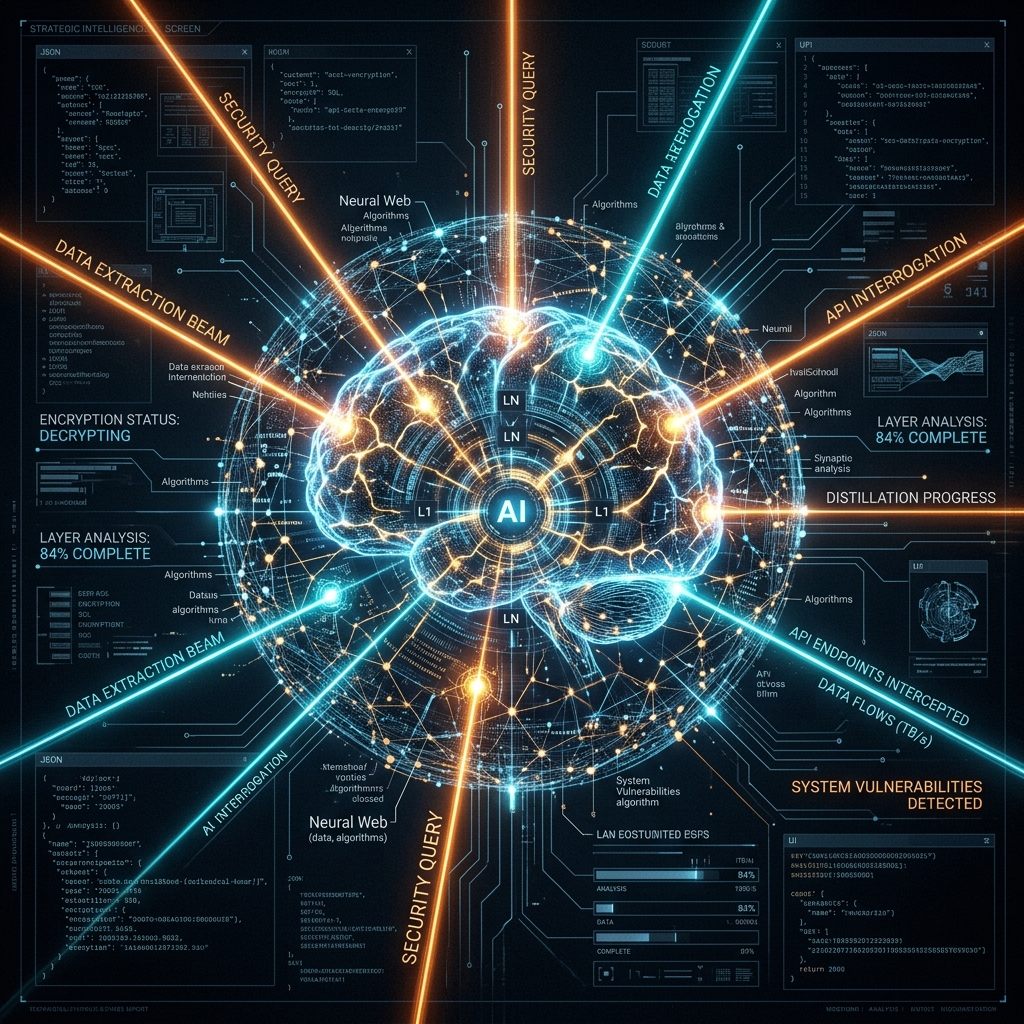
The Weaponization of the Neural Matrix
For the first two years of the artificial intelligence boom, geopolitical conflict was fought primarily through external physical sanctions: denying foreign adversaries access to advanced lithography machines, restricting shipments of high-bandwidth GPUs, and sanctioning specific foreign semiconductor fabrication entities. That phase was merely the prelude. The real battle has now penetrated the internal mathematics of the neural network itself. Model weights, attention matrices, alignment vectors, and training checkpoints are no longer considered software artifacts; they are officially treated as dual-use munitions, classified intelligence assets, and the ideological frontline of technological sovereignty.
1. The Evolution of Export Controls: From Silicon to Synapses
In October 2022, and with sweeping expansions in late 2023 and 2024, the United States Department of Commerce through the Bureau of Industry and Security (BIS) fundamentally re-engineered global technology trade. Utilizing the extraterritorial authority of the Foreign Direct Product Rule (FDPR), the United States imposed strict export prohibitions on advanced AI hardware, banning the sale of processors exceeding specific interconnect bandwidth and total processing performance (TPP) metrics to strategic competitors.
However, physical hardware controls alone possess a severe structural limitation: once silicon is manufactured, it can be smuggled, rerouted through third-party intermediary nations, or reverse-engineered through state-sponsored industrial espionage.
Recognizing this reality, sovereign security apparatuses have shifted their regulatory and enforcement gaze to the intangible software artifact produced by those chips: the model weights.
Under executive national security directives and international regulatory pacts, any artificial intelligence model trained using cumulative compute exceeding a statutory threshold (such as 10^26 total floating-point operations, or FLOPs) is automatically classified as a potential dual-use biological, cybernetic, and military weapon. The organizations developing these models are subject to mandatory national security reporting, red-team auditing, and draconian supply-chain controls.
2. Model Weights as Classified Strategic Reserves
To understand why sovereign states are obsessively guarding model weights, one must grasp what a modern frontier checkpoint file actually represents.
A checkpoint containing 500 billion FP8 parameters represents the distilled output of hundreds of millions of dollars in capital expenditure, 100,000 advanced GPUs operating continuously for six months, and hundreds of gigawatt-hours of electrical energy. It is an extraordinary concentration of economic, scientific, and kinetic leverage stored in a binary file that can comfortably sit on a high-capacity solid-state drive (SSD).
If an adversary successfully exfiltrates those weights through a cyber intrusion or compromised insider, they instantly capture the entire multi-hundred-million-dollar investment without consuming a single kilowatt of training electricity or purchasing a single restricted lithography tool.
Consequently, the world's leading artificial intelligence laboratories are transitioning into secure, compartmentalized defense enclaves:
- Air-Gapped Training Fabrics: Model weights and training clusters are completely disconnected from the public internet during sensitive training runs to prevent real-time exfiltration.
- Hardware-Enforced Weight Encryption: Weights are encrypted at rest and in transit using hardware security modules (HSMs) and decrypted only inside the confidential computing enclaves (AMD SEV-SNP, Intel TDX, Nvidia H100 Confidential Computing) of the GPUs themselves.
- Counter-Intelligence Personnel Audits: AI researchers working on pre-training and alignment algorithms are now subjected to rigorous background checks and counter-intelligence surveillance previously reserved for nuclear weapons engineers.
| Geopolitical Era | Core Strategic Asset | Choke Point Mechanism | Enforcement Instrument |
|---|---|---|---|
| Cold War I (1947–1991) | Fissile Material & Centrifuges | Uranium hexafluoride enrichment facilities | CoCom export controls; IAEA inspections |
| Silicon Era (1992–2021) | Semiconductor Fabrication Tooling | Extreme Ultraviolet (EUV) photolithography | Wassenaar Arrangement; BIS Entity Lists |
| AI Cold War II (2022–Present) | Frontier Model Weights & Alignment Vectors | 10^26 FLOP compute runs; high-density interconnects | National Defense Authorization Act (NDAA); ITAR classification |
3. Alignment as Ideological Border Control
The battlefield extends far beyond raw cognitive capability; it encompasses the ideological, moral, and political worldview embedded into the model through Reinforcement Learning from Human Feedback (RLHF) and Constitutional AI.
Every foundation model possesses an implicit political philosophy encoded into its attention weights. When a user asks a model to interpret historical events, evaluate economic policies, or define human rights, the model’s response is governed by the alignment rules enforced by its developers and national overseers:
- Western Frontier Models: Aligned around democratic pluralism, constitutional free speech norms, diversity constraints, and commercial copyright protections.
- Authoritarian Sovereign Models: Aligned under strict state censorship directives, where queries concerning political dissidents, state territorial sovereignty, or historical massacres return hardcoded refusals or state-approved propaganda narratives.
In the emerging multipolar world, adopting a foreign nation's foundation model is the technological equivalent of outsourcing your national education curriculum, legal interpretation, and media apparatus to a foreign intelligence agency. This is why sovereign states are rejecting foreign closed-source APIs and investing billions into developing national language models that reflect their own indigenous history, religion, and cultural values.
"Whoever controls the alignment vectors of the dominant neural network controls the default epistemic reality of the next generation."
— Tanvir Newaz, Digital Growth Architect
4. The Open-Weights Conundrum: Freedom vs. Proliferation
This geopolitical confrontation has triggered a fierce philosophical and regulatory civil war in the technology sector: The Open-Weights Debate.
On one side, open-source advocates, European startups (like Mistral), and technology conglomerates (like Meta) argue that releasing model weights democratizes innovation, prevents monopolistic lock-in by cloud hyperscalers, and enables independent security auditing.
On the other side, national security officials and closed-model laboratories contend that releasing open weights of models approaching or exceeding human reasoning capabilities is reckless proliferation. Once model weights are published to the public internet, safety guardrails and alignment filters can be easily stripped via fine-tuning (using techniques like LoRA or unlearning algorithms) in a matter of hours, potentially enabling threat actors to synthesize chemical toxins, engineer novel biological pathogens, or automate offensive zero-day cyber attacks.
5. Strategic Takeaways for Enterprise Sovereignty
For global enterprise executives and technical leaders operating in this fractured geopolitical landscape, staying neutral is no longer a viable strategy:
- Implement Model Sovereignty Architecture: Avoid building mission-critical business processes entirely atop closed foreign APIs that can be shut down overnight due to sudden trade sanctions or geopolitical policy pivots. Maintain on-premises or regionally hosted open-weights models as operational fallbacks.
- Audit Supply-Chain Geopolitics: Review the jurisdiction and ownership of your entire software and compute stack. If your enterprise handles sensitive intellectual property, medical records, or critical financial infrastructure, ensure that your data never passes through compute clusters subject to foreign subpoena or surveillance laws.
- Fine-Tune Proprietary Alignment: Do not accept the default moral, legal, or commercial assumptions of off-the-shelf models. Use parameter-efficient fine-tuning (PEFT) on your own corporate policy documents, ethical frameworks, and commercial contracts to ensure your AI systems behave according to your company's sovereign standards.
The battle for the 21st century is no longer waged solely across physical oceans or airspace. The modern frontier is mathematically inscribed into the weights, biases, and alignment vectors of artificial minds.

Tanvir Newaz
Digital Growth Architect & Advanced SEO Strategist
Operating out of Gulshan, Dhaka, Tanvir builds custom AI competitor models, Python search pipelines, and sovereign digital growth systems for market leaders worldwide.