The AI Compute War Has Begun
The Industrial Reality of Modern Artificial Intelligence
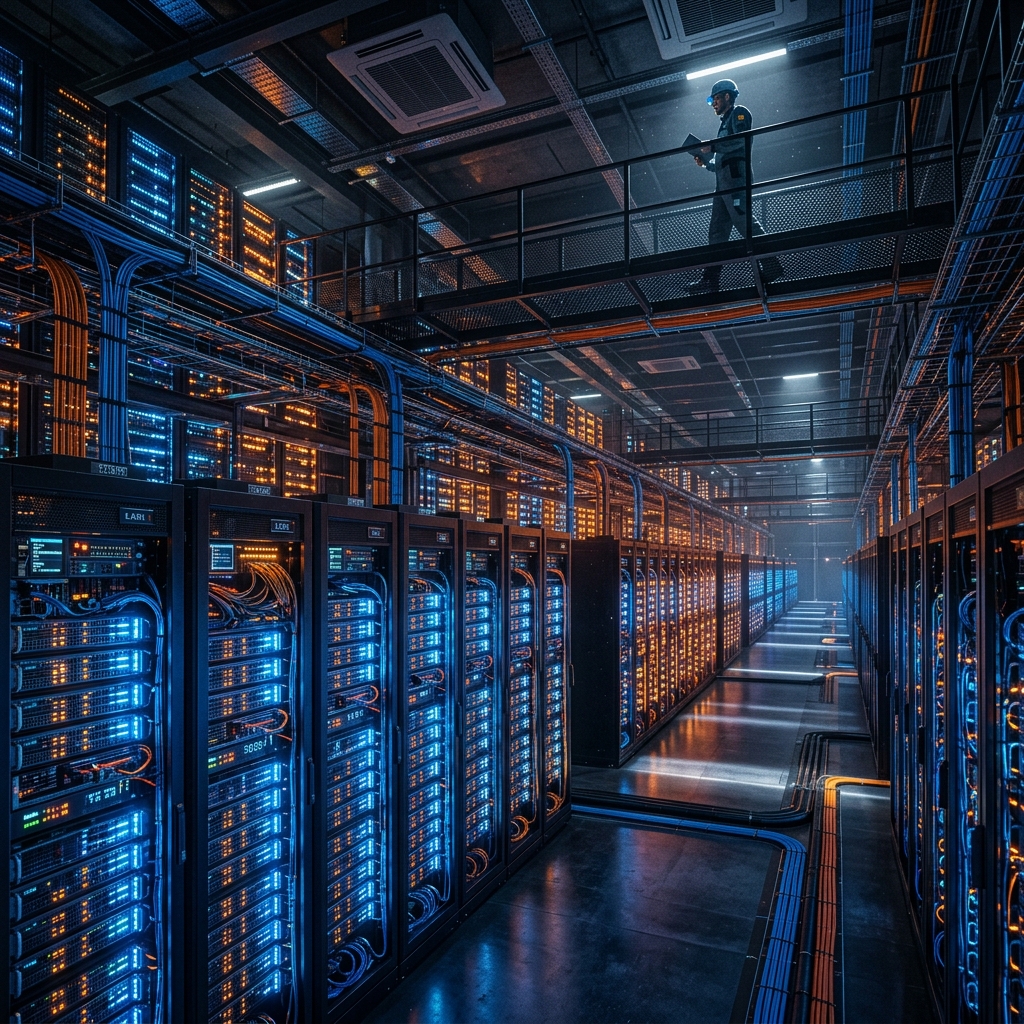
Public discourse surrounding artificial intelligence remains fixated on conversational interfaces, user prompts, and marketing automation. Meanwhile, deep beneath the software surface, a brutal physical war is being waged across five continents. This is not a battle of code; it is an industrial slugfest fought over concrete foundations, high-voltage switchyards, liquid chilling manifolds, and allocations of high-bandwidth memory. The limiting factor of artificial intelligence is no longer human imagination—it is the raw, thermodynamic limits of electrical grids and silicon packaging lines.
1. The Thermodynamic Wall: The Collapse of Air-Cooled Computing
For four decades, the standard data center architecture relied on forced-air cooling. Server racks were arranged in hot-aisle and cold-aisle configurations, with powerful industrial fans circulating chilled air through server chassis to dissipate heat generated by 250-watt to 350-watt CPUs.
Modern AI accelerators have pulverized this operational baseline.
An individual Nvidia Blackwell B200 chip consumes 1,000 to 1,200 watts of electrical power. When integrated into a single NVL72 server rack—combining 72 Blackwell GPUs and 36 Grace CPUs into a unified computational fabric—the rack draws an astonishing 120 to 135 kilowatts of continuous electricity. Attempting to cool a 130-kilowatt rack with traditional forced air is thermodynamically impossible; the air simply cannot absorb thermal energy rapidly enough to prevent the silicon dies from melting through their thermal throttling limits.
The entire industry has been forced into an emergency mechanical migration:
- Direct-to-Chip Liquid Cooling: Pumping deionized water and dielectric coolants through precision copper cold plates mounted directly atop GPU logic dies.
- Coolant Distribution Units (CDUs): Installing massive multi-megawatt heat exchangers capable of circulating hundreds of gallons of coolant per minute across thousands of server blades with zero leak tolerance.
- Immersion Cooling Tanks: Submerging entire server assemblies into specialized fluorochemical dielectric liquids that boil and condense in sealed thermodynamic cycles.
| Server Architecture | Thermal Design Power (TDP) | Cooling Requirement | PUE Impact |
|---|---|---|---|
| Legacy Enterprise Rack (2018) | 10 kW – 15 kW per rack | Standard Forced Cold-Aisle Air | 1.4 – 1.6 PUE |
| Nvidia Hopper H100 Cluster | 40 kW – 50 kW per rack | High-CFM Rear-Door Heat Exchangers | 1.2 – 1.3 PUE |
| Nvidia Blackwell NVL72 Cluster | 120 kW – 135 kW per rack | Direct-to-Chip Liquid Manifolds | 1.08 – 1.15 PUE |
| Next-Gen Exascale Pod (2028+) | 250 kW – 500 kW per pod | Full Two-Phase Dielectric Immersion | < 1.05 PUE |
2. The Interconnect Bottleneck: Why Optical Fabrics Rule the Cluster
In frontier artificial intelligence training, having 100,000 fast GPUs is completely useless if those chips cannot communicate with one another at nanosecond latency.
Modern large language models are distributed across thousands of accelerators using tensor parallelism, pipeline parallelism, and data parallelism. During every backward pass of backpropagation, the gradients computed on GPU #1 must be synchronized with the weights residing on GPU #50,000. If the communication fabric stalls, thousands of multi-million-dollar processors sit idle, burning expensive electricity while waiting for packets.
This makes the interconnect fabric the hidden kingmaker of the Compute War:
- NVLink and NVSwitch Dominance: Nvidia’s proprietary NVLink 5.0 delivers 1.8 terabytes per second of bidirectional bandwidth per GPU, allowing 72 Blackwell chips to behave as a single massive virtual GPU with 30 terabytes of shared memory.
- The Optical Transceiver Crunch: Connecting clusters requires millions of 800-gigabit and 1.6-terabit optical transceivers, pushing global laser diode manufacturers to their absolute capacity limits.
- Co-Packaged Optics (CPO): Traditional copper traces on printed circuit boards generate unsustainable electrical resistance at 200 Gbps per lane. The industry is aggressively transitioning to silicon photonics, integrating laser transceivers directly onto the multi-chip substrate.
3. The Gridlock: High-Voltage Substations and the Nuclear Solution
The most staggering constraint of the Compute War is not found in Taiwan or Silicon Valley—it is found in the physical electrical utility infrastructure.
A modern frontier AI training campus requires between 500 megawatts and 2 gigawatts of electrical capacity. For comparison, the Hoover Dam generates approximately 2 gigawatts of total capacity. Connecting a single gigawatt data center campus to a regional power grid is the engineering equivalent of plugging an entire industrial metropolis into a single high-voltage transmission corridor.
This has created an acute infrastructure logjam:
- Transformer Lead Times: The lead time for 500kV step-up substation transformers has stretched to 4 years due to global shortages of grain-oriented electrical steel and specialized copper winding equipment.
- Regulatory Rejection: Grid operators such as PJM Interconnection in the Eastern United States are facing fierce public and industrial pushback over fears that hyper-scale data centers will strain local electrical reserves, inflate residential utility bills, and trigger rolling brownouts.
Consequently, hyperscalers are racing to execute dedicated Nuclear Power Purchase Agreements (PPAs). By co-locating data center campuses behind the meter at existing nuclear power stations or investing directly in Small Modular Reactor (SMR) development, technology giants are securing baseload, carbon-free electricity insulated from public utility volatility.
"In the 19th century, the geopolitical race was for coal and iron. In the 20th century, it was for crude oil and uranium. In the 21st century, it is for high-voltage transmission lines connected to advanced silicon packaging."
— Tanvir Newaz, Digital Growth Architect
4. The Silicon Geopolitics: A Fragile Monopolistic Supply Chain
The global artificial intelligence revolution rests atop an astonishingly fragile supply chain pyramid:
- The Lithography Monopoly: ASML in Veldhoven, Netherlands, is the sole entity on Earth capable of manufacturing Extreme Ultraviolet (EUV) lithography systems. Each machine contains hundreds of thousands of precision components, mirrors polished to atomic tolerances by Carl Zeiss in Germany, and high-power CO2 lasers.
- The Foundational Foundry: TSMC in Taiwan produces over 90% of the world's frontier AI silicon. A single geological disruption or geopolitical blockade in the Taiwan Strait would instantaneously freeze global technological progression.
- The Memory Cartel: High-Bandwidth Memory (HBM3e) is controlled by a triumvirate: SK Hynix, Samsung, and Micron. SK Hynix commands over 50% of the market due to its proprietary Advanced Mass Reflow Molded Underfill (MR-MUF) packaging technology.
5. Strategic Recommendations: Thriving in the Era of Compute Scarcity
For enterprise leaders and technology executives, recognizing the reality of the Compute War is essential to preventing catastrophic architectural missteps:
- Avoid Over-Reliance on Monolithic Public APIs: Commercial API pricing from hyperscalers will inevitably fluctuate as electricity costs rise and compute capacity is reallocated to high-margin sovereign defense contracts. Architect your software systems with model-agnostic abstraction layers that can seamlessly swap inference engines.
- Embrace Aggressive Model Compression: Prioritize 4-bit and 8-bit quantization (AWQ, GPTQ), distillation, and speculative decoding. A 7-billion parameter model fine-tuned on pristine proprietary data running on edge hardware will consistently outperform a generic 400-billion parameter model at 1/50th of the operational cost.
- Secure Strategic Hardware Commitments Early: If your enterprise roadmap requires dedicated GPU training runs, secure multi-year compute commitments and reserved instances immediately. In the Compute War, waiting for on-demand cloud pricing is an existential vulnerability.
The Compute War will not be won by those with the most articulate marketing or the slickest user interfaces. It will be won by those who control the physical inputs of the intelligence economy: silicon, switches, cooling manifolds, and uninterrupted electrical power.

Tanvir Newaz
Digital Growth Architect & Advanced SEO Strategist
Operating out of Gulshan, Dhaka, Tanvir builds custom AI competitor models, Python search pipelines, and sovereign digital growth systems for market leaders worldwide.