The AI Control War Is Moving to Washington: The Next Moat Is Regulatory Access
The AI Control War Is Moving to Washington: The Next Moat Is Regulatory Access
WASHINGTON — For decades, the undisputed capital of the technology universe was a quiet strip of asphalt in Menlo Park, California, known as Sand Hill Road. It was here that billions of dollars changed hands, fortunes were minted, and the unwritten rules of the digital age were drafted by venture capitalists and rogue founders. But the geographic center of gravity for the world's most consequential technology is shifting, rapidly and decisively, 2,800 miles to the east.
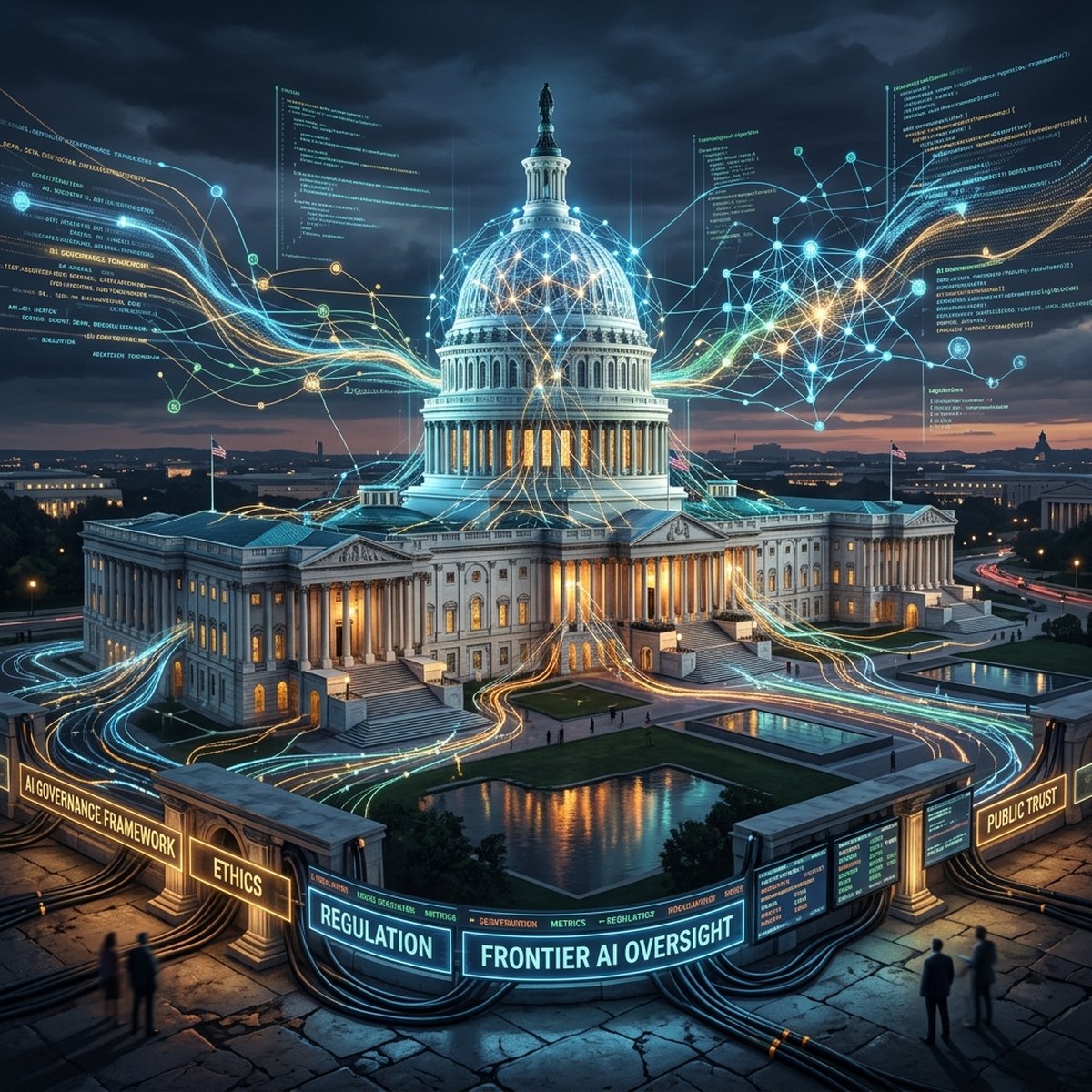
The next frontier of artificial intelligence will not just be coded in Silicon Valley. It will be legislated, regulated, and procured in Washington, D.C.
According to a recent report by Axios, Anthropic CEO Dario Amodei is scheduled for a private White House dinner with President Trump. This is not a mere courtesy call or a standard photo opportunity. It is a striking symbol of a broader, systemic transformation in the tech industry: the realization that the ultimate barrier to entry in the artificial intelligence race is no longer just compute, capital, or talent. It is government access.
For the vanguard of AI development—companies like OpenAI, Anthropic, Google, and Meta—the regulatory framework is no longer viewed merely as a compliance hurdle or an afterthought. It is an arena of intense, zero-sum competition. Frontier AI companies are increasingly treating government policy as an integral part of their strategic environment.
In Silicon Valley parlance, a "moat" is a competitive advantage that protects a company's market share and profitability from rivals. For years, the AI stack was defined by a ruthless, four-layer progression: Technology, Infrastructure, Capital, and Distribution.
First came the technological breakthroughs—the transformer architectures and diffusion models that made generative AI possible. Then came infrastructure, as companies scrambled to secure tens of thousands of specialized Nvidia GPUs to train their models. Next was the massive influx of capital required to fund these compute clusters, with funding rounds routinely stretching into the billions. Finally, there was distribution—integrating these models into consumer products and enterprise software to reach billions of users.
But today, the stack has evolved. A fifth layer has emerged, one that sits above the rest and exerts absolute control over the entire ecosystem: Regulation.
Regulatory access and favorable government policy can influence every underlying layer of the AI stack. It dictates compute deployment, energy access, national-security procurement, model standards, legal liability, export controls, and enterprise adoption. In the high-stakes chess match of artificial intelligence, the companies that shape the rules will inevitably control the board.
The OpenAI Playbook: U.S.-Led International Standards
The pivot toward regulatory capture is most evident in the recent maneuvers of OpenAI. Over the past year, OpenAI CEO Sam Altman has embarked on a relentless global diplomatic tour, meeting with heads of state in Europe, the Middle East, and Asia. But the company's most aggressive policy push is happening right in Washington.
OpenAI has publicly called for U.S.-led international AI standards, advocating for a global coalition that would establish rigorous safety, security, and deployment protocols for frontier models. On its face, this is a responsible, forward-thinking proposal designed to prevent an uncontrolled race to the bottom in AI safety.
However, viewed through the lens of corporate strategy, it is a brilliant competitive moat.
By pushing for stringent, complex, and highly formalized international standards, OpenAI is advocating for a regulatory environment that heavily favors incumbent giants. The cost of compliance in a heavily regulated, internationally standardized AI ecosystem would be astronomically high. Only the most well-capitalized companies—those capable of fielding massive legal, compliance, and government relations teams—would be able to navigate such a labyrinth.
This strategy effectively pulls up the drawbridge behind the current market leaders. It threatens to stifle open-source competitors and underfunded startups who simply cannot afford to meet the exhaustive auditing and reporting requirements that a U.S.-led global standard would inevitably demand. OpenAI is attempting to construct a regulatory environment where safety standards double as insurmountable barriers to entry.
Anthropic’s Counter-Offensive: Safety as a Weapon
If OpenAI's strategy is to define the international framework, Anthropic’s strategy is to position itself as the indispensable, trusted advisor to the American government.
Dario Amodei’s scheduled White House dinner with President Trump underscores this approach. Anthropic, founded by former OpenAI researchers who left over safety and commercialization concerns, has meticulously crafted its brand around "constitutional AI" and rigorous safety protocols. They have sold themselves to policymakers not just as a technology company, but as the adults in the room—the responsible stewards of a potentially dangerous technology.
This direct engagement with the highest levels of the executive branch is a tactical masterstroke. By cementing a relationship with the White House and key regulatory agencies, Anthropic ensures that its proprietary safety frameworks and testing methodologies become the de facto standard for the federal government.
When the U.S. government decides what constitutes a "safe" model—and more importantly, which models are deemed too dangerous to be deployed or exported—Anthropic wants its own internal guidelines to be the blueprint. If Anthropic can convince the administration that its approach to safety is the only acceptable paradigm, it immediately casts suspicion on competitors whose architectures or deployment strategies differ. In Washington, framing the narrative is half the battle, and Anthropic is playing a very sophisticated game of narrative control.
The Bottleneck of Power: Energy and Infrastructure
The battle over regulation extends far beyond algorithmic safety; it strikes at the very physical infrastructure required to sustain the AI boom. Training and running the next generation of frontier models requires an almost unfathomable amount of computing power, which in turn requires a staggering amount of electricity.
We are entering an era of gigawatt data centers—sprawling complexes that consume as much power as a small city. Securing the land, the power purchase agreements, and the grid connections for these facilities is no longer a matter of simply signing a check. It requires navigating a Byzantine maze of federal, state, and local regulations. It involves negotiating with public utility commissions, navigating environmental impact reviews, and securing federal permits for alternative energy sources, including nuclear power.
Here, regulatory access is paramount. A tech company that has the ear of the Department of Energy, the Federal Energy Regulatory Commission (FERC), or influential state governors will have a massive advantage in securing the necessary permits to build the infrastructure of tomorrow.
If Company A can secure federal backing to fast-track a nuclear-powered data center, and Company B is mired in three years of state-level environmental litigation, Company A will win the AI race. The physical scaling laws of AI dictate that the regulatory timeline for infrastructure is now the limiting factor for technological progress.
The Trillion-Dollar Checkbook: Defense and Procurement
The U.S. government is not just a regulator; it is the most lucrative customer on the planet. The Department of Defense, the intelligence community, and the broader federal bureaucracy are currently in the early stages of a massive technological modernization effort.
Securing government contracts is about more than just revenue. It is about validation. Earning FedRAMP authorization, securing Impact Level 6 (IL6) clearance for classified environments, and becoming deeply embedded in the national security apparatus provides a company with an aura of invincibility. It signals to enterprise customers in highly regulated industries—like finance and healthcare—that the company's technology is bulletproof.
Furthermore, becoming a critical supplier to the defense establishment creates a powerful layer of political protection. Companies like Palantir and Anduril have long understood this dynamic. If a frontier AI company's models become integral to U.S. cyber defense, intelligence analysis, or autonomous weapons systems, that company effectively becomes a protected entity. The government will inherently shield its key defense contractors from overly burdensome domestic regulation that might hinder their operational capabilities.
Export Controls: The Geopolitics of AI
The AI control war is also a geopolitical struggle, and the primary weapon wielded by Washington is the export control regime. The U.S. Commerce Department has already implemented sweeping restrictions on the sale of advanced AI chips, notably those from Nvidia, to strategic rivals like China.
However, export controls are increasingly being applied not just to hardware, but to the models themselves and the capital structures surrounding them. The U.S. government is actively scrutinizing the deployment of frontier AI models in the Middle East—such as the massive investments pouring into the UAE—fearing that these regions could serve as backdoors for Chinese access to American technology.
For AI companies, navigating this geopolitical minefield requires deep ties to the State Department and the Commerce Department. A misstep in international deployment can result in crippling sanctions or the revocation of critical export licenses. Conversely, companies that align their international expansion strategies with U.S. foreign policy objectives can expect to receive diplomatic cover and preferential treatment when negotiating international partnerships.
Liability and the Open Source Debate
Looming over all of this is the existential question of liability. Who is responsible when an AI model generates deepfakes that manipulate an election, provides instructions for synthesizing biological weapons, or hallucinates a catastrophic financial decision?
The debate over liability is deeply intertwined with the debate over open-source vs. closed-source models. Companies like Meta, which have championed the open-source release of highly capable models like LLaMA, argue that open access drives innovation and democratization.
But closed-source advocates, including OpenAI and Anthropic, argue that open-sourcing frontier models is a recipe for disaster, as the guardrails can be easily stripped away by malicious actors.
This is where the regulatory war becomes a fight for survival. If policymakers decide to impose strict liability on the developers of open-source models for any downstream misuse of their technology, the open-source ecosystem would be decimated overnight. A regulatory mandate requiring stringent pre-deployment safety testing and continuous monitoring is fundamentally incompatible with the open-source ethos.
The closed-source incumbents are heavily incentivized to lobby for a liability regime that makes open-source development legally toxic. By shaping the legal definition of negligence and liability in the AI space, these companies can neutralize one of their biggest competitive threats without ever having to write a better line of code.
The New Reality
The era of "move fast and break things" is officially dead. In the realm of frontier artificial intelligence, moving fast without permission is a profound strategic error. The new ethos is "move strategically and write the laws."
Dario Amodei’s dinner at the White House and Sam Altman’s calls for global standards are not anomalies; they are the new standard operating procedure. The AI stack has forever changed. The brilliant engineers and visionary researchers still matter, but their work is increasingly subjugated to the quiet, unglamorous work of lobbyists, lawyers, and government relations executives.
The AI control war has moved to Washington. And in this new theater of conflict, the companies that fail to build a regulatory moat will quickly find themselves besieged, outmaneuvered, and obsolete. The next great AI monopoly won't just be forged in the data center—it will be legislated into existence on Capitol Hill.
← Back to OSIRIS Series