The AI Power Crunch Just Got Real: Why Crusoe Walked Away From $1.25 Billion of Turbines
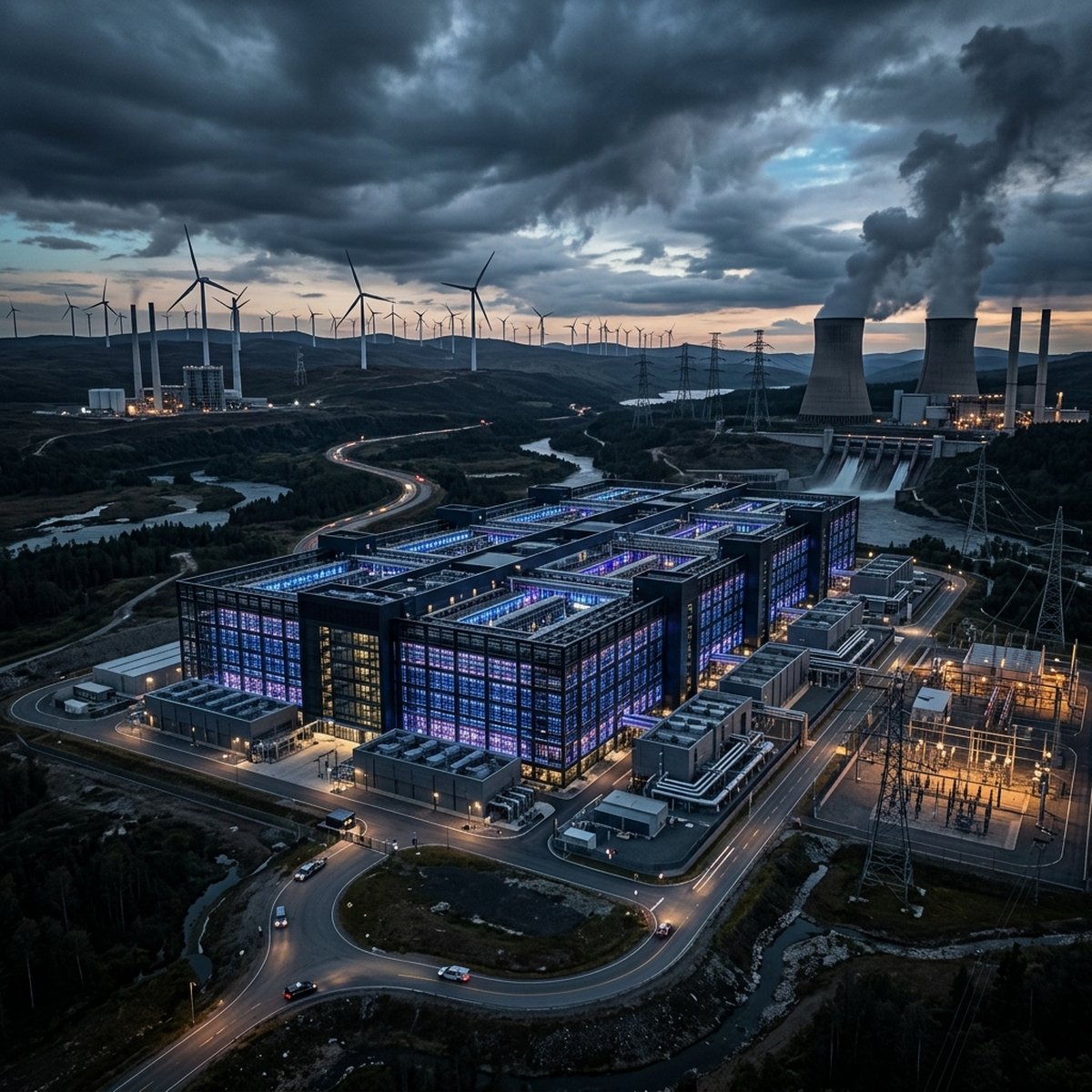
The AI Power Crunch Just Got Real: Why Crusoe Walked Away From $1.25 Billion of Turbines
NEW YORK — The artificial intelligence revolution is no longer just about silicon, algorithms, or the esoteric mathematics of neural networks. It is about something much more primal, much more physical, and infinitely more constrained: electricity.
For the past three years, the narrative defining the AI boom has been one of computing power—who has the most Nvidia H100 GPUs, who is building the largest data center, and who can train the most massive language model. But as the sheer scale of these operations expands, a new bottleneck has emerged, threatening to throttle the entire industry. The AI power crunch has arrived, and it is reshaping the strategies of the world's most valuable companies.
Nowhere is this shift more evident than in the recent, quiet collapse of a massive infrastructure deal. Crusoe Energy, a pioneer in utilizing stranded energy for computing, recently walked away from a planned $1.25 billion partnership with Boom. The deal would have seen Crusoe acquire 29 stationary 42-megawatt turbines. It was a massive procurement, intended to power the next generation of AI data centers. But Crusoe canceled it, stating simply that the turbines no longer fit its "near-term primary power mix."
At first glance, this might look like a simple supply chain adjustment or a minor hiccup in a fast-moving industry. But for those paying close attention to the intersection of energy and technology, Crusoe's decision is a bellwether. The important story here isn't that Boom lost a billion-dollar deal. It is that AI data centers are becoming so monstrously large, and their power requirements so complex, that energy strategy is now being optimized strictly on a site-by-site basis. The era of the universal, one-size-fits-all energy solution for data centers is officially over.
The End of the One-Size-Fits-All Data Center
To understand why Crusoe abandoned the turbine deal, one must look at the divergence in how modern AI mega-campuses are being built and conceived. Crusoe's flagship project—a colossal 1-gigawatt campus in Abilene, Texas, designed to serve the combined needs of Oracle and OpenAI—will be entirely grid-powered. This site benefits from Texas's deregulated energy market, the specific grid interconnections available in that region, and ERCOT’s distinct structure that allows rapid deployment if the economics make sense.
Contrast this with another major campus planned for Microsoft. For that project, the strategy is entirely different. Instead of relying solely on the grid, that site is expected to utilize onsite gas turbines for behind-the-meter generation. The requirements of the site, the local grid capacity, the regulatory environment, and the time-to-market demands dictated a localized power generation strategy.
This divergence is the crux of the new AI energy paradigm. A 42-megawatt turbine, while powerful and highly efficient, represents a specific type of capital expenditure and a specific type of operational model. If your largest near-term deployments are grid-connected in Texas or require entirely different generation profiles elsewhere, committing $1.25 billion to a single turbine technology becomes an inflexible liability rather than a strategic asset. The AI infrastructure race is moving too fast for rigid hardware commitments that span half a decade.
AI infrastructure has matured rapidly. The companies building these digital behemoths are no longer just server hosts; they are de facto energy strategists. They must evaluate grid connections, gas pipelines, nuclear availability, renewable credits, and battery storage viability for every single parcel of land they consider.
An Enormous Electricity Shortfall Looming on the Horizon
The urgency of this site-by-site optimization is driven by a terrifying macroeconomic reality: the United States is running out of readily available electricity.
A recent report by the Financial Times highlighted estimates of a potentially enormous U.S. electricity shortfall directly associated with the rapidly expanding demand from data centers. For decades, electricity demand in the U.S. remained relatively flat. Energy efficiency improvements in appliances, manufacturing, and LED lighting offset population growth and economic expansion. Power companies grew accustomed to a predictable, stagnant market, investing in maintenance rather than massive capacity expansion.
Then came generative AI, fundamentally altering the calculus of national energy consumption.
A single ChatGPT query requires roughly ten times the electricity of a standard Google search. When that compute intensity is multiplied by billions of users and compounded by the unimaginably power-hungry process of training frontier models—which require clusters of 100,000 or more GPUs running at maximum capacity for months on end—the energy requirements become staggering. A single rack of modern AI servers can consume 100 to 120 kilowatts, compared to the 10 to 15 kilowatts typical of traditional cloud servers.
Utility companies are suddenly receiving requests for grid interconnections of 500 megawatts, 1 gigawatt, or even 2 gigawatts. To put that in perspective, a 1-gigawatt data center requires the equivalent power output of a full-sized nuclear reactor. It is enough electricity to power a medium-sized city like San Francisco. And tech companies want multiple of these built by the end of the decade, demanding power yesterday.
The grid, built over a century for a fundamentally different pattern of energy consumption, simply cannot handle this load. High-voltage transmission lines take a decade or more to permit and build, trapped in endless loops of local opposition, environmental reviews, and bureaucratic red tape. Transformers are facing years-long supply chain backlogs. The physical infrastructure of the American energy system is buckling under the weight of the AI revolution, forcing tech companies to take matters into their own hands.
The Physics of AI: From Silicon to Substation
To fully grasp the magnitude of the problem, one must understand the physics of AI training. A GPU like the Nvidia H100 or the upcoming Blackwell architecture is essentially a tiny, incredibly dense space heater that happens to do math. When a cluster of 100,000 of these chips is linked together to train a next-generation model like GPT-5 or its successors, they draw power continuously, without fluctuation, 24 hours a day, 7 days a week, for months.
This creates a unique profile known as "baseload" demand. Unlike a residential neighborhood, where power usage spikes in the evening and drops at night, an AI data center never sleeps. It demands constant, unwavering voltage. If the power dips for even a fraction of a second, the training run can crash, potentially wasting millions of dollars in compute time.
Therefore, tech companies cannot simply rely on solar panels that stop producing at night or wind turbines that sit idle on calm days. They need firm, dispatchable power. This stringent requirement drastically narrows their options and elevates the complexity of their energy strategy.
The Energy Portfolio Optimization Problem
Because the grid cannot expand fast enough to meet their timelines, AI companies and data center developers have had to get creative. The race for AI dominance is no longer just a software engineering challenge; it has morphed into a massive energy portfolio optimization problem.
Every major tech company is now juggling a complex matrix of power sources, acting less like software vendors and more like utility executives:
The Grid: Still the cheapest and most reliable source where capacity exists. But "where capacity exists" is the operative phrase. Companies are scouring the country, looking for retiring coal plants, abandoned steel mills, or industrial sites with robust legacy grid connections that can be repurposed for data centers. The strategy here is scavenging for existing high-voltage infrastructure rather than waiting for new lines to be built.
Natural Gas: For sites where grid power is insufficient or years away from delivery, onsite natural gas generation has become the bridge fuel for the AI era. Gas turbines can be deployed relatively quickly, provide baseload power 24/7, and offer the reliability AI training demands. However, this creates intense friction with the aggressive carbon-neutral pledges made by companies like Microsoft, Google, and Amazon. It is a Faustian bargain: burn gas today to win the AI race, or wait for clean energy and lose to competitors.
Nuclear Power: The holy grail of clean, baseload power. Tech companies are increasingly viewing nuclear energy as the long-term, structural solution to the AI power crunch. Amazon's recent $650 million purchase of a data center campus adjacent to the Susquehanna nuclear plant in Pennsylvania, and Microsoft's unprecedented deal with Constellation Energy to restart the Three Mile Island nuclear plant, signal a massive shift in corporate energy strategy. These are not symbolic gestures; they are multi-decade, multi-billion-dollar commitments to nuclear fission.
Furthermore, small Modular Reactors (SMRs) are attracting billions in tech investment. Companies like OpenAI’s Sam Altman are backing advanced fission startups, hoping to eventually deploy mini-reactors directly alongside data centers. Though SMRs remain years away from commercial deployment, they represent the ultimate vision of behind-the-meter, zero-carbon power.
Renewables and Storage: Solar and wind are crucial for meeting ESG goals, but their intermittency makes them inherently unsuited for the relentless demands of an AI training cluster. Consequently, tech companies are exploring massive battery storage deployments to smooth out the supply curve. However, the scale required for a gigawatt campus remains economically and logistically daunting. Batteries can bridge a gap of a few hours, but they cannot replace a gigawatt of baseload generation over a windless, cloudy week.
Behind-the-Meter Generation: The trend toward true energy independence is accelerating. Instead of waiting for utility companies to build substations and transmission lines, developers are increasingly building their own microgrids. This approach, which often combines onsite gas turbines, solar arrays, and massive battery banks, bypasses utility bottlenecks entirely. It requires data center companies to effectively become full-fledged power producers, managing complex generation portfolios right next to their server racks.
The Geopolitics of AI Power
This energy crunch also carries profound geopolitical implications. The race to develop artificial general intelligence (AGI) is viewed by policymakers in Washington and Beijing as a matter of national security. But AGI requires infrastructure on a scale humanity has never seen.
If the United States cannot streamline its permitting processes for transmission lines and power generation, the AI boom could be geographically constrained. China, with its centrally planned economy and massive capacity for rapid infrastructure deployment, is building out nuclear, solar, and coal power at a blistering pace. While the U.S. currently leads in AI software and chip design, a failure to solve the domestic electricity bottleneck could cede ground to international competitors who are willing and able to rapidly build the necessary power infrastructure.
The Carbon Paradox and the Future of Tech
The underlying tension in this entire energy scramble is the environmental cost. The major players in the AI race—Microsoft, Google, Amazon, Meta—have all made loud, public commitments to achieve net-zero carbon emissions by 2030 or 2040.
The AI power crunch has put those commitments on a catastrophic collision course with their core business imperatives. Google recently admitted that its greenhouse gas emissions have climbed 48% over the past five years, largely due to data center expansion. Microsoft has seen similar, troubling increases in its carbon footprint.
When the choice is between missing out on the next generation of AI dominance or burning natural gas to power a new data center today, the tech giants are overwhelmingly choosing the latter. They are relying on complex carbon offset markets and hoping that massive future investments in nuclear, next-generation geothermal, and fusion energy will eventually offset their current carbon binge.
This paradox is why energy strategy is now discussed in tech boardrooms with the same gravity as product roadmaps and algorithmic breakthroughs. The companies that win the AI race will not just be the ones with the smartest engineers; they will be the ones who manage to secure the gigawatts required to train their models without completely torching their environmental credibility, alienating their environmentally conscious workforce, or running afoul of emerging regulatory limits.
Conclusion: The Power Brokers of Tomorrow
The canceled $1.25 billion turbine deal between Crusoe and Boom is a quiet footnote in the loud, chaotic narrative of the AI boom, but it speaks volumes about where the industry is heading. We have moved past the initial gold rush of securing GPUs. We are now in the grueling, infrastructure-heavy, capital-intensive phase of building the physical factories that will manufacture artificial intelligence.
These factories are ravenous. They require rivers of water for cooling and oceans of electricity to operate. The realization that there is no single solution to this energy deficit—no magic turbine that can be deployed universally—has fundamentally changed how data centers are conceived, financed, and built.
The AI power crunch is real, it is here, and it is forcing the brightest minds in technology to become the most aggressive energy prospectors on the planet. From the grid-connected plains of West Texas to the shadow of dormant nuclear reactors in Pennsylvania, the future of AI is being written not just in Python and C++, but in copper wire, steel pipelines, uranium fuel rods, and the relentless, unforgiving pursuit of raw electrical power.
The masters of the universe are no longer just software coders sitting in Silicon Valley cafes. They are the energy strategists, the utility negotiators, and the infrastructure developers. The age of the energy-optimized mega-campus has begun, and the tech industry will never be the same.
← Back to OSIRIS Series