The AI Race Has Hit the Power Grid: Compute Is No Longer the Bottleneck — Electricity Is
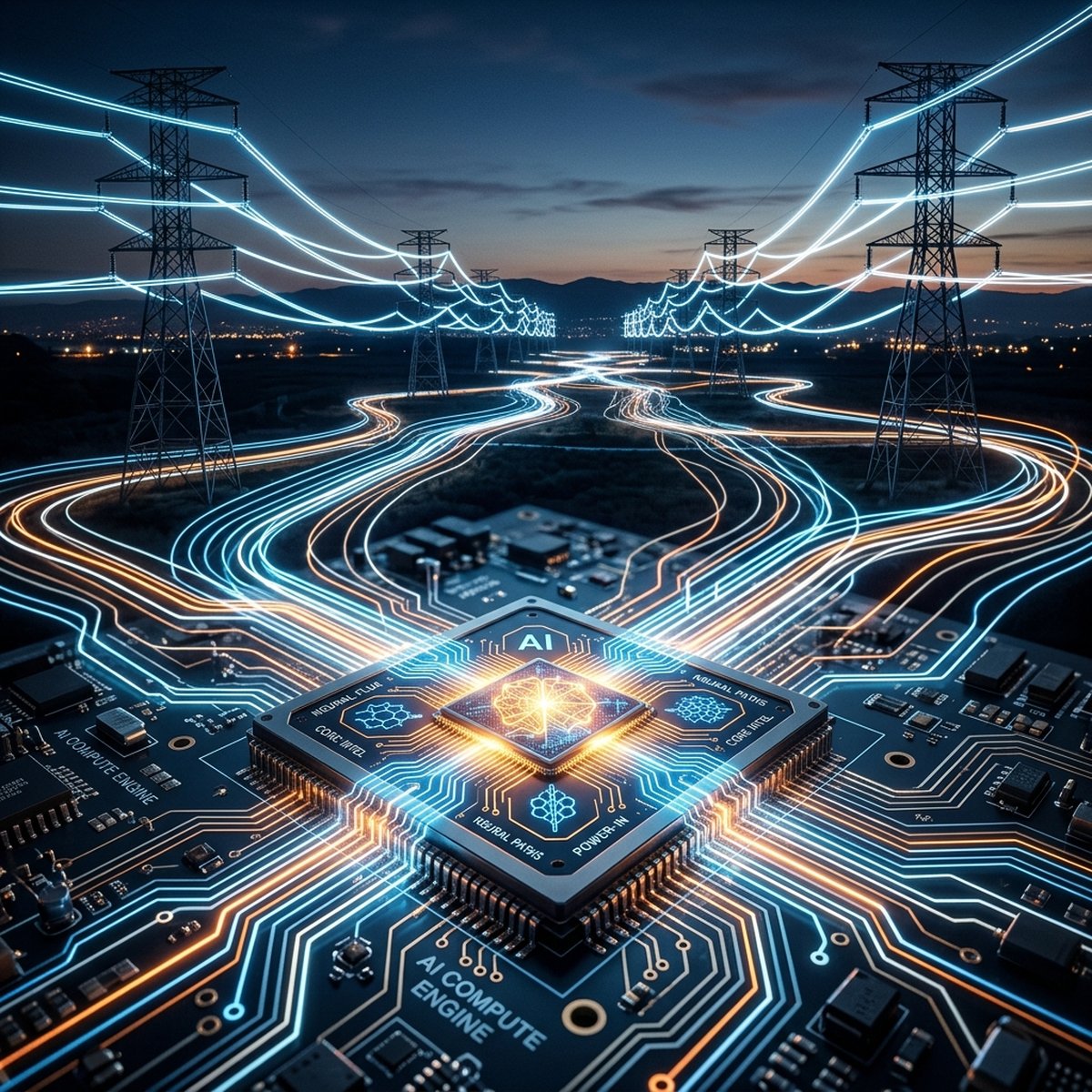
The AI Race Has Hit the Power Grid: Compute Is No Longer the Bottleneck — Electricity Is
The narrative that has defined the last two years of the artificial intelligence boom is one of silicon and software. It is a story told in the soaring stock prices of chip designers like NVIDIA, the multi-billion-dollar investments by tech behemoths like Microsoft, Google, and Meta, and the seemingly magical capabilities of large language models. The consensus has been simple: the entity with the most computing power wins.
But a profound shift is occurring, one that is largely invisible to the software engineers in Silicon Valley but blaringly obvious to utility executives in places like Ashburn, Virginia, and Phoenix, Arizona. The race for artificial general intelligence (AGI) has slammed headfirst into the physical limits of the modern world. We are no longer constrained by our ability to design faster chips or raise unprecedented amounts of capital. We are constrained by our ability to keep the lights on.
The bottleneck in the AI revolution is no longer compute. It is electricity.
The Silicon Mirage
For decades, the technology industry operated under the comforting umbrella of Moore’s Law. As transistors shrank, computing power grew exponentially without a commensurate explosion in power consumption. This efficiency miracle allowed data centers to scale quietly in the background, absorbing vast amounts of the world’s digital exhaust without dramatically moving the needle on global energy demand.
That era is decisively over.
The transition from traditional cloud computing to accelerated computing—the kind required to train and run models like OpenAI's GPT-4 or Google's Gemini—requires a fundamental reimagining of the data center. A standard server rack in a conventional data center might draw between 5 and 10 kilowatts (kW) of power. A single rack packed with NVIDIA's latest H100 or B200 GPUs can draw upwards of 40 to 100 kW.
NVIDIA can produce more powerful chips. Cloud companies can build more data centers. AI labs can raise more capital. But none of those actions automatically conjures electricity from the ether. We have built the engines of the future, but we forgot to drill the wells to fuel them.
The Gigawatt Hunger
To understand the scale of the impending crisis, one must look at the raw physics of AI. Training a state-of-the-art foundational model takes tens of thousands of GPUs running continuously for months. Inferencing—the process of querying the model once it is trained—consumes even more energy in aggregate as millions of users integrate AI into their daily workflows. A single ChatGPT query is estimated to consume nearly ten times the electricity of a standard Google search.
When you extrapolate that across the global economy, the numbers become staggering. According to recent estimates from the Financial Times and various energy watchdogs, the United States could face a substantial power shortfall as data center demand surges. The International Energy Agency (IEA) projects that global electricity consumption from data centers, AI, and cryptocurrency could double by 2026, adding an electricity demand roughly equivalent to the entire country of Japan.
In the United States, which houses the lion's share of global AI infrastructure, the grid is already groaning under the weight of this new reality. Utility companies, accustomed to single-digit percentage growth over decades, are suddenly receiving requests from tech giants for multi-gigawatt interconnection agreements—amounts of power that typically require years, if not decades, of planning and construction to deliver.
The Gridlock: Outdated Infrastructure Meets Exponential Demand
The American electrical grid has been called the largest and most complex machine ever built. It is also one of the oldest. Much of the transmission infrastructure in the U.S. was constructed in the mid-20th century, designed for a different era of industrialization and population distribution.
Integrating massive new loads into this aging system is not simply a matter of throwing a switch. It requires extensive upgrades to substations, high-voltage transmission lines, and local distribution networks. And that assumes the power generation is already there. Often, it is not.
In Northern Virginia’s “Data Center Alley,” the undisputed capital of the internet, the local utility, Dominion Energy, sent shockwaves through the tech industry recently when it warned that it might not be able to meet the power demands of new data center developments in certain areas. This wasn’t a temporary glitch; it was a structural warning sign. When the internet's most critical hub runs out of juice, the entire global supply chain of compute is forced to reroute.
The Downstream Migration
This structural reality forces a radical reappraisal of where value will accrue in the next phase of the AI boom. If electricity is the ultimate limiting factor, then the next trillion-dollar AI infrastructure opportunity may sit outside the traditional AI industry entirely.
This gives savvy observers and capital allocators a powerful new lens through which to view the technology landscape. The bottleneck is migrating downstream.
The causal chain is starkly linear: AI requires data centers. Data centers require electricity. Electricity requires transmission. Transmission requires generation. Generation requires storage and fuel. All of this requires land. And land requires permitting.
Suddenly, the most critical players in the AI race are not just software developers in San Francisco, but utility regulators in Ohio, nuclear engineers in Georgia, and land developers in Texas. The center of gravity is shifting from the virtual realm to the heavy, physical, industrial base of the economy.
The Capital Market Lens: Tracing the Money from Silicon to Dirt
Let’s follow this capital market lens to its logical conclusions.
First, the immediate beneficiaries of this power crunch are the entities that already possess secured power rights and operational data centers with room to expand. "Time-to-power" is the new metric of desperation in the cloud industry. A data center with guaranteed power today is worth exponentially more than a planned facility struggling through the interconnection queue.
Next comes the transmission and electrical equipment sector. The transformers, switchgear, and high-voltage cables required to build these massive facilities are facing their own supply chain crises. Lead times for large power transformers have stretched from months to years. Companies that manufacture the literal nuts and bolts of the electrical grid are experiencing a renaissance driven by the AI boom.
Further down the chain is generation. The tech industry, bound by ambitious carbon-neutrality pledges, desperately wants this new power to be clean. But wind and solar, while crucial, are intermittent. AI data centers operate at 100% utilization, 24 hours a day, 7 days a week. They require baseload power—steady, reliable, and uninterrupted.
The Nuclear Renaissance and Alternative Energy
This demand for clean, firm baseload power has sparked a sudden and serious reappraisal of nuclear energy. Tech billionaires are pouring capital into next-generation nuclear technologies, including small modular reactors (SMRs) and even fusion startups.
Microsoft recently signed an agreement to purchase power from a planned revival of the Three Mile Island nuclear plant in Pennsylvania—a deeply symbolic move that underscores the tech industry's hunger for carbon-free gigawatts. Amazon has purchased a data center campus in Pennsylvania directly adjacent to the Susquehanna nuclear power plant, securing a massive, direct source of zero-carbon energy.
But new nuclear builds take time—often a decade or more. In the interim, tech companies are being forced to make uncomfortable compromises. In some regions, the desperate need for power is extending the lifespans of coal and natural gas plants that were previously slated for retirement. The irony is palpable: the technology hailed as the savior of humanity might temporarily derail its climate goals.
The Regulatory Quagmire: Permitting as the Ultimate Chokepoint
Even if the capital is available and the technology is proven, the physical build-out of this infrastructure faces an even more formidable adversary: the permitting process.
In the United States, building a new high-voltage transmission line or a major power plant is an exercise in bureaucratic endurance. Projects must navigate a labyrinth of local, state, and federal regulations, environmental impact studies, and community opposition. The National Environmental Policy Act (NEPA), designed to protect the environment, is frequently weaponized by NIMBY (Not In My Back Yard) activists to delay or kill critical infrastructure projects.
This regulatory friction is the ultimate chokepoint in the AI supply chain. A GPU can be manufactured in a matter of months. Software can be deployed globally in an instant. But a high-voltage transmission line takes an average of ten to twelve years to permit and build in the U.S.
If we cannot streamline the process of building physical infrastructure, the United States risks forfeiting its lead in artificial intelligence simply because it could not cut through its own red tape.
Geopolitical Stakes: The Race for Compute Sovereignty
This domestic challenge has profound geopolitical implications. Artificial intelligence is not just a commercial technology; it is a matter of national security. The nation that controls the most capable AI models will possess a decisive economic and military advantage.
Other nations, unencumbered by the same level of regulatory friction or democratic opposition, are moving rapidly to build out their own AI infrastructure. Sovereign wealth funds in the Middle East are aggressively investing in massive data center complexes, leveraging their abundant energy resources to attract global tech talent.
If the U.S. cannot solve its power and permitting bottlenecks, the center of global compute could shift to jurisdictions that can. The race for AI is fundamentally a race for energy, and energy dominance has always been the cornerstone of geopolitical power.
Conclusion: The Physical Limits of the Digital Mind
The narrative of artificial intelligence is undergoing a necessary correction. We are waking up from the illusion that software exists purely in the cloud, untethered from the physical realities of the earth.
The cloud is heavy. It is made of concrete, steel, copper, and silicon. And above all, it is thirsty for power.
The next frontier of the AI revolution will not be conquered solely by writing better code. It will be conquered by pouring concrete, laying transmission lines, and splitting atoms. The trillion-dollar opportunities of the coming decade will be found in the unglamorous, heavy industries that have been neglected for a generation.
As we push the boundaries of what machine intelligence can achieve, we are reminded of a fundamental law of physics: every action has an equal and opposite reaction. In the quest to build a digital brain, we must first rebuild the physical body that sustains it. The bottleneck has moved, and the real work is just beginning.
← Back to OSIRIS Series