The AI Shopping War Has Begun: Google, Amazon and OpenAI Are Fighting for the Moment Before You Buy
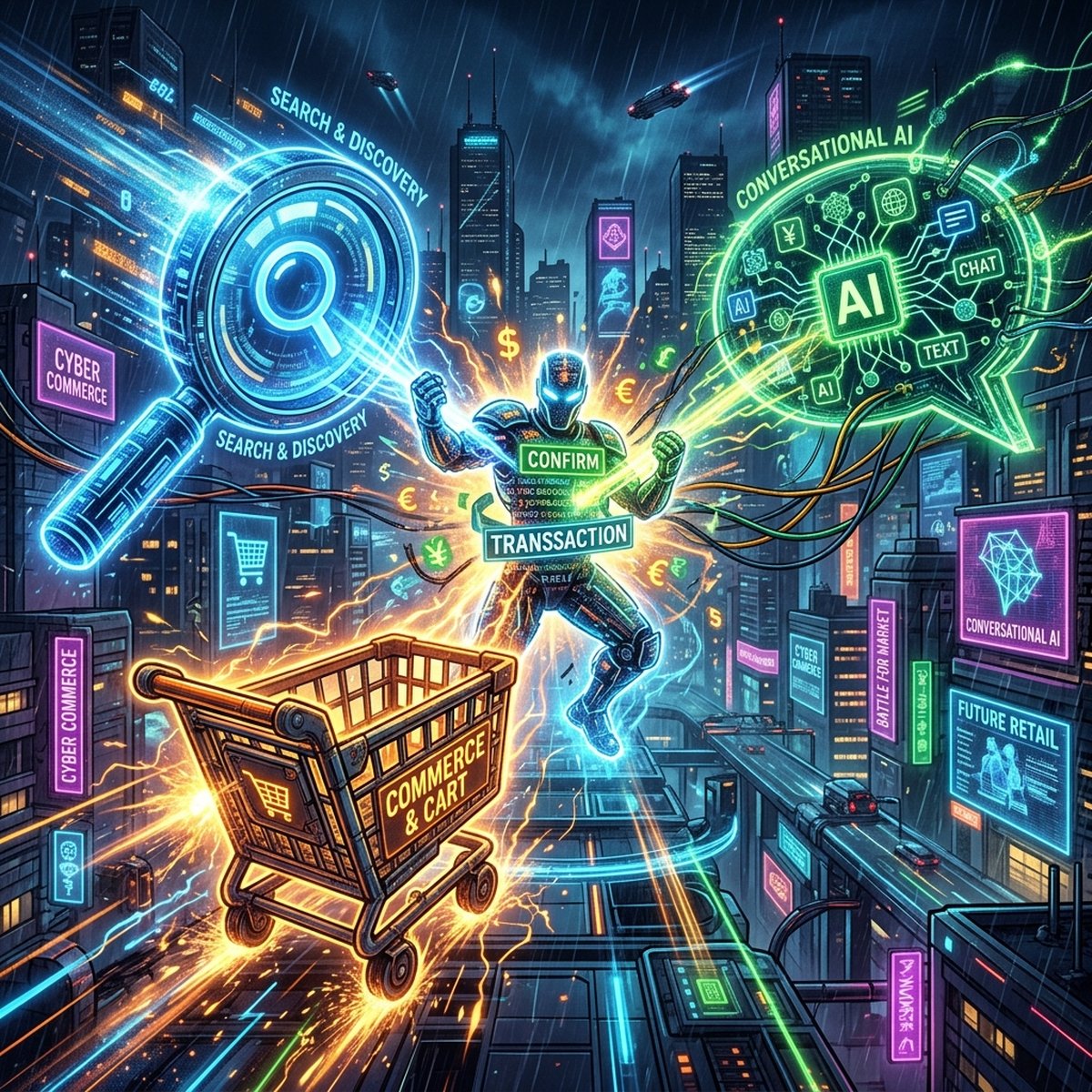
The AI Shopping War Has Begun: Google, Amazon, and OpenAI Are Fighting for the Moment Before You Buy
NEW YORK — For a quarter of a century, the digital economy has been governed by a simple, universally understood ritual: You want something, you type it into a search box, you hit enter, and you scroll through a list of blue links. That ritual is dead. The search box is rapidly being replaced by the chat window, the voice assistant, and the autonomous digital agent. And with this paradigm shift, the most lucrative battleground in the history of the consumer internet has been thrown wide open.
Welcome to the AI Shopping War.
It is a high-stakes, three-way collision between the titans of Silicon Valley and Seattle. In one corner stands Google, the undisputed monarch of search intent, scrambling to protect its empire from conversational interlopers. In the second corner looms Amazon, the unstoppable juggernaut of logistics and fulfillment, determined to maintain its grip on the final mile of commerce. In the third corner is OpenAI, the insurgent architect of the generative AI revolution, armed with unparalleled conversational fluency but lacking a native retail footprint.
The prize is not merely the ability to answer a user's question. The prize is absolute control over the "Moment Before You Buy"—the critical, fleeting window when a consumer's vague desire crystallizes into a transactional command.
This isn't just about a smarter search engine or a more intuitive shopping cart. It is the dawn of "agentic commerce," a new era where artificial intelligence doesn't just show you products—it compares them, negotiates prices, builds your cart, and executes the purchase on your behalf. The winner of this war won't necessarily be the company with the smartest language model. It will be the company that can successfully synthesize the most valuable combination of intent, inventory, identity, payments, and fulfillment.
The New Paradigm: From Search to Agency
To understand the magnitude of this shift, one must understand how archaic the current e-commerce experience actually is. When you shop online today, the cognitive load rests entirely on your shoulders. You must navigate a labyrinth of SEO-optimized garbage, parse dubious reviews, compare specifications across a dozen open browser tabs, track price histories on third-party sites, and finally navigate a clunky checkout process.
Generative AI promises to obliterate this friction. The moment before you buy is no longer a solitary slog through a digital strip mall; it is a collaborative dialogue with an omniscient concierge.
Imagine telling your AI, "Find me a durable, waterproof tent for a family of four that weighs under 10 pounds and can be delivered before my trip to Yosemite this Friday. Oh, and make sure it has good reviews from actual backpackers, not just bots. Buy the best option under $300."
In the era of agentic commerce, the AI does exactly that. It doesn't give you a list of links. It gives you a receipt.
This level of automation requires a profound technological stack. It demands real-time access to global inventory, an intimate understanding of the user's historical preferences, secure payment credentials, and a logistical network capable of executing the physical delivery. No single company currently possesses all of these pieces perfectly integrated, which is precisely why Google, Amazon, and OpenAI are currently engaged in a frantic arms race to build or acquire them.
Amazon: The Fortress of Fulfillment
If e-commerce is a war of logistics, Amazon is the undisputed superpower. The Seattle behemoth possesses structural advantages that its rivals can only dream of. It doesn't just know what people want to buy; it has the warehouses, the delivery vans, and the Prime-subscribing, credit-card-on-file customer base to make it happen instantly.
Amazon has recently unveiled its vision for the future of shopping: a deeply integrated AI assistant capable of performing complex reasoning over its vast catalog. Amazon claims its shopping AI can dynamically compare products based on nuanced criteria, analyze historical price fluctuations to advise on the optimal time to buy, build customized shopping carts based on conversational prompts, and even automate purchases for recurring needs.
"Amazon's moat isn't its algorithms; it's its infrastructure," notes a prominent retail analyst. "You can have the most brilliant conversational AI in the world, but if it can't guarantee that the product is actually in stock and will arrive on my doorstep in 48 hours, the consumer doesn't care."
Amazon's strategy is to transform its familiar search bar into an intelligent agent that lives across its ecosystem—from the Amazon app to Alexa-enabled devices. By integrating generative AI directly into the buying flow, Amazon aims to collapse the funnel. It wants to capture the user the moment a need arises, locking them into the Amazon ecosystem before they even think to consult a general-purpose search engine like Google or a chatbot like ChatGPT.
Crucially, Amazon owns the user's purchasing history. Its AI knows you return shoes that are too narrow. It knows you prefer organic dog food. It knows how often you run out of laundry detergent. This historical context is invaluable for an AI agent tasked with making autonomous purchasing decisions on a user's behalf.
Google: The Emperor of Intent
If Amazon owns the end of the funnel, Google has traditionally owned the beginning. For two decades, Google has been the default starting point for human curiosity. It captures "intent" better than any entity on earth. When you want to learn about a product, compare reviews, or find a local retailer, you Google it.
But the rise of conversational AI represents an existential threat to Google's traditional ten-blue-links model. If users can get direct answers from a chatbot, why would they click on search ads?
To defend its empire, Google is weaponizing its most potent, yet often overlooked, asset: The Shopping Graph.
Google's Shopping Graph is a colossal, dynamic dataset containing more than 60 billion product listings, continuously updated in real-time by merchants around the globe. It tracks pricing, availability, local inventory, reviews, and detailed specifications across millions of disparate websites.
"People fundamentally misunderstand Google's position in commerce," a former Google executive told CNN. "Google doesn't need to own warehouses. It owns the map of the global economy."
Google is currently building a Universal Commerce Protocol (UCP) designed to power agentic commerce. The goal of UCP is to standardize how AI agents interact with merchants. Instead of a user browsing a website, a Google-powered AI agent would query the Shopping Graph, identify the optimal product across the entire internet (not just Amazon's walled garden), and execute the transaction seamlessly using Google Pay.
Google's pitch is universality. It wants to be the intelligent layer that connects a consumer with any merchant in the world, whether it's a massive retailer like Walmart or a local boutique down the street. Furthermore, Google possesses massive contextual data through Gmail, Google Maps, and YouTube. A Google AI knows you just booked a flight to Aspen (Gmail), watches snowboarding tutorials (YouTube), and navigates to sporting goods stores (Maps). This holistic view of the user's life provides a rich tapestry of intent that Amazon's purely retail-focused data cannot match.
OpenAI: The Architect of Conversation
The wild card in this conflict is OpenAI. Unlike Google and Amazon, OpenAI has no legacy retail business to protect. It has no warehouses, no native payment network, and no shopping graph.
What it does have is the interface of the future.
ChatGPT has become the fastest-growing consumer application in history because it offers a fundamentally new way for humans to interact with information. OpenAI has captured conversational intent. When millions of users want to brainstorm gift ideas, plan a vacation wardrobe, or troubleshoot a complex tech purchase, they are increasingly turning to ChatGPT rather than traditional search engines.
OpenAI is aggressively moving to monetize this conversational intent by developing an Agentic Commerce Protocol. This protocol aims to allow ChatGPT—and eventually autonomous agents powered by OpenAI's models—to interface directly with third-party retailers and service providers.
OpenAI's strategy is to be the ultimate aggregator. By owning the conversational layer, it can sit on top of the entire internet, acting as a universal concierge. If a user asks ChatGPT to buy a product, ChatGPT can route that request to the most appropriate fulfillment partner, taking a cut of the transaction.
"OpenAI is trying to abstract away the retailer entirely," says a venture capitalist focused on AI. "If I trust my AI agent to find the best TV for my budget, I don't care if it comes from Best Buy, Target, or a direct-to-consumer brand. I just care that the AI did the work."
However, OpenAI faces significant hurdles. To truly execute agentic commerce, it must convince users to hand over their payment credentials and shipping information—a level of trust that Amazon and Google have spent decades building. Furthermore, it must forge partnerships with a fragmented landscape of retailers to ensure its agents have real-time access to inventory and pricing data. Without reliable execution, an AI concierge is merely an advice column.
The Battle for Identity and Payments
As the war escalates, the battle lines are converging on two critical chokepoints: identity and payments.
Conversational AI is useless if it cannot finalize the transaction. The friction of entering a 16-digit credit card number and a shipping address is the enemy of agentic commerce. The winner will be the platform that offers a frictionless, one-click (or zero-click) checkout experience across the entire internet.
Amazon already has hundreds of millions of active credit cards on file and is attempting to extend its reach beyond its own domain through initiatives like "Buy with Prime," which allows independent merchants to offer Amazon's checkout and fulfillment on their own websites.
Google counter-attacks with Google Pay, integrated deeply into Android and the Chrome browser, offering seamless checkout across millions of third-party sites. Google's advantage is its omnipresence on the mobile devices where the majority of shopping occurs.
OpenAI, lacking a native payment rail, may be forced to partner with massive fintech players like Stripe or PayPal to bridge the gap between conversational intent and financial execution. Or, it may rely on Apple Pay, deeply integrating its agents into the iOS ecosystem, a strategy hinted at by recent partnerships between OpenAI and Apple.
The Dawn of Agentic Commerce
We are rapidly approaching a threshold where the AI transitions from an advisor to an actor.
In the first phase of the AI revolution, we used language models to generate text and answer questions. In the next phase, we will grant them agency. We will give them budgets, parameters, and goals, and we will unleash them onto the internet to negotiate, purchase, and manage our physical lives.
Imagine an AI agent that monitors your pantry via smart sensors, recognizes that you are low on coffee, analyzes the global commodities market, predicts a price spike due to a drought in Brazil, and autonomously pre-orders a three-month supply from a local roaster at a locked-in rate—all without you ever opening an app.
This is the promise of agentic commerce. It is a fundamental rewiring of the consumer economy.
The Winner Takes All
Who will win the AI Shopping War?
Amazon has the unassailable advantage of physical infrastructure and habitual consumer trust. If it can successfully evolve Alexa and its search bar into a truly intelligent, proactive agent, it will be incredibly difficult to dislodge from the center of American commerce.
Google has the advantage of universal discovery. Its Shopping Graph is the most comprehensive map of global retail in existence. If Google can deploy autonomous agents that seamlessly navigate this graph and execute purchases across any merchant, it can offer a level of choice and flexibility that Amazon's closed ecosystem cannot match.
OpenAI has the advantage of the blank slate. It is not constrained by legacy business models. It owns the most advanced conversational interface and has captured the imagination of the public. If it can successfully plug into external payment and fulfillment networks, it could become the universal interface for everything.
The reality, however, is that the ultimate victor won't simply have the "best AI." The algorithms will inevitably commoditize. The large language models will converge in capabilities.
The company that dominates the next era of retail will be the one that successfully integrates the disparate fragments of the modern economy. It will seamlessly fuse the initial spark of consumer intent with the vast web of global inventory. It will secure user identity and streamline payments. And crucially, it will ensure that the physical product actually arrives at the physical door.
The AI Shopping War is not just a battle for the mind. It is a battle for the moment before you buy—and the trillion-dollar ecosystem that follows. The search box is dead. Long live the agent.
← Back to OSIRIS Series