Google Is Turning Gemini Into a Checkout Machine — And Search May Never Be the Same
Google Is Turning Gemini Into a Checkout Machine — And Search May Never Be the Same
San Francisco (CNN) — For a quarter of a century, the fundamental anatomy of the internet has been predicated on a simple, unspoken contract: you tell a search engine what you want, and it points you to where you can get it. It was the ultimate digital concierge, holding the door open to a sprawling, chaotic marketplace. You did the walking. You opened the tabs. You compared the prices. And, crucially, you pulled out your credit card to make the final transaction.
That era is quietly and decisively coming to an end.
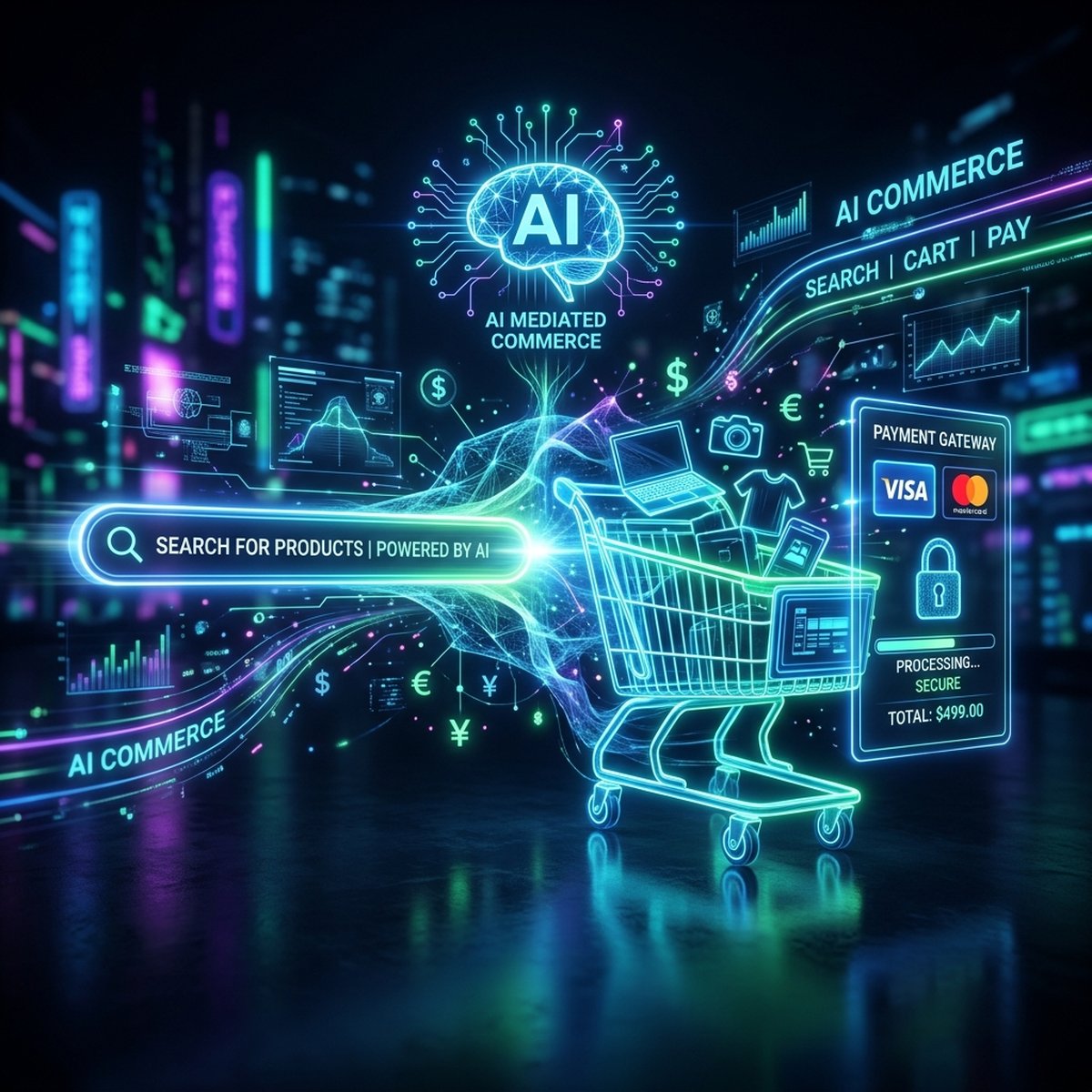
Google, the architect of the modern internet's front door, is executing a massive paradigm shift. It is no longer satisfied with merely directing traffic. Instead, the tech behemoth is fundamentally re-engineering its core AI model, Gemini, to collapse the entire e-commerce funnel—intent, discovery, comparison, decision, and checkout—into a single, frictionless, AI-mediated transaction.
This isn't just about adding a "shopping tab" to a chatbot. It is a calculated move to transform the search engine from an information retrieval system into an autonomous transaction engine.
The signals are hidden in plain sight: the development of a Universal Commerce Protocol, the introduction of a Universal Cart, and the whispered dawn of an Agent Payments Protocol. Together, these technologies represent the infrastructure for "agentic commerce"—a future where AI doesn't just help you shop; it shops for you. And if Google succeeds, the way we interact with the web, brands, and our own bank accounts may never be the same.
The Collapse of the Search Funnel
To understand the magnitude of this shift, one must look at the traditional e-commerce journey. Marketing professionals have long obsessed over "the funnel," a step-by-step pathway starting at broad awareness and narrowing down to a final purchase.
In the old web, this funnel was deeply fragmented. You might see a shoe on Instagram (Awareness), search for its reviews on Google (Research), watch a video on YouTube (Consideration), and finally navigate to Nike.com or Amazon to buy it (Conversion). Each step required a different interface, a different mental model, and a different set of clicks. This friction was accepted as a necessary evil of digital life.
Enter Gemini. Google’s flagship generative AI model is rapidly evolving from a conversational oracle into a digital proxy. By integrating search capabilities directly into Gemini’s reasoning engine, Google is attempting to devour the funnel whole.
Imagine asking Gemini, "Find me a pair of running shoes suitable for high arches, under $150, that I can get by Friday, and buy the best option in a size 10."
In the past, a search engine would yield a list of articles about high arches, a few sponsored shopping links, and perhaps a map to a local Foot Locker. You would then begin the grueling work of cross-referencing tabs.
Under the new model, Gemini doesn't give you links. It gives you a confirmed order number. It parses your intent, scours the inventory of thousands of retailers, compares shipping times, evaluates the credibility of the sellers, applies your pre-saved payment information, and executes the checkout. The ten blue links are gone. In their place is a receipt.
The Hidden Architecture: UCP and Agent Payments
The magic trick of agentic commerce relies on profound infrastructural changes behind the scenes. This isn't happening through traditional web scraping or simple API calls. Google is actively building the rails for a new kind of internet economy.
The most critical piece of this puzzle is what industry insiders refer to as the Universal Commerce Protocol (UCP). Historically, e-commerce has been balkanized. Shopify stores speak one language, Magento speaks another, and Amazon operates in its own walled garden. For an AI to navigate this effectively, it requires a standardized method of understanding product catalogs, inventory levels, and pricing dynamically. UCP acts as the Rosetta Stone, allowing Gemini to query global inventory in real-time, regardless of the underlying platform.
Tethered to the UCP is the concept of the Universal Cart. Currently, if you want to buy a tent from REI, a sleeping bag from Patagonia, and a flashlight from a boutique brand, you must navigate three separate checkout flows. The Universal Cart aggregates these items into a single, seamless meta-cart hosted within the Gemini interface. The AI negotiates the individual transactions on the backend, while presenting the user with a single, unified "Approve Purchase" button.
But perhaps the most radical development is the Agent Payments Protocol (APP). The traditional checkout process—entering credit card numbers, CVVs, and billing addresses—is designed for humans. Agents operate differently. APP involves cryptographic tokenization that grants an AI model constrained, provisional authority to spend money on your behalf.
You might authorize Gemini to spend up to $200 per month on household staples, or pre-approve a one-time transaction up to a specific limit for a flight. The agent holds the wallet, executing micro-transactions or complex purchases in milliseconds, communicating directly with financial institutions via secure APIs that bypass the traditional browser checkout entirely. This shifts the AI from an advisory role into a fiduciary one.
The Competitive Crucible: OpenAI and Amazon
Google is acutely aware that it is not operating in a vacuum. The race to dominate agentic commerce is arguably the most consequential battle in the tech industry today, far surpassing the initial skirmishes over generative text.
OpenAI, armed with massive funding and the ubiquity of ChatGPT, is aggressively pursuing its own Agentic Commerce Protocol. Sam Altman's company recognizes that while they don't have Google's decades of search dominance, they possess immense consumer mindshare. OpenAI's strategy focuses heavily on product discovery and reasoning—allowing ChatGPT to act as a hyper-intelligent personal shopper that can navigate the web autonomously via its own set of tools and plugins. OpenAI's advantage lies in its agnosticism; it doesn't have an entrenched search advertising business to protect, allowing it to aggressively pursue pure transaction models.
Amazon, meanwhile, views agentic commerce as an existential imperative. The e-commerce titan has already integrated its generative AI assistant, Rufus, deeply into its shopping app. Amazon's play is "Alexa for Shopping" on steroids. While Google and OpenAI must figure out how to interface with millions of disparate merchants, Amazon already owns the inventory, the logistics, and the credit cards. When you ask Rufus to find the best blender, it doesn't need to scour the web; it just searches the Amazon warehouse. Amazon's closed loop gives it a massive advantage in reliability and fulfillment speed, even if it lacks the open-web discovery capabilities of Google.
The tension between these three approaches—Google’s open-web funnel collapse, OpenAI’s agnostic autonomous agents, and Amazon’s closed-loop retail AI—will define the next decade of consumer technology.
The Economics of the Agentic Web
For Google, the transition to agentic commerce is not just a product update; it is a fundamental rewiring of its multi-billion-dollar business model.
For over twenty years, Google has minted money through AdWords. Advertisers pay for clicks, hoping that a user who clicks on a sponsored link will eventually buy something. But in an agent-mediated world, users don't click links. They ask an agent to solve a problem.
If Gemini is tasked with buying the best noise-canceling headphones, how does a brand like Bose or Sony ensure they are the ones selected by the algorithm?
The advertising model of the future will likely pivot from "pay-per-click" (PPC) to what we might call "pay-per-prompt" or "pay-per-placement" within the AI's consideration set. Brands won't be bidding for human eyeballs; they will be optimizing their data feeds and paying premiums to influence the agent's decision matrix.
This raises profound questions about neutrality and antitrust. If Google's Gemini is doing the buying, will it favor retailers who pay higher placement fees? Will it steer users toward merchants that use Google Pay? The opacity of AI reasoning makes traditional algorithmic audits incredibly difficult. When a search engine ranks a page poorly, you can analyze the SEO. When an AI refuses to buy your product, the reasons are buried in a black box of neural weights and hidden parameters.
Furthermore, the Universal Cart model positions Google to demand a toll on transactions. If Google is handling the checkout, it is highly probable they will seek a percentage of the sale, shifting their revenue stream from pure advertising to a hybrid of advertising and direct commerce taxation—much to the horror of independent retailers already squeezed by Amazon.
The Trust Deficit and the Danger of Hallucinated Purchases
The utopian vision of frictionless AI shopping glosses over a massive, looming vulnerability: trust.
Large Language Models are inherently probabilistic. They are designed to predict the next most likely word, not to execute flawless logic. They are notorious for "hallucinations"—inventing facts, misinterpreting data, and confidently presenting false information as truth.
In a conversational setting, a hallucination is annoying. In agentic commerce, a hallucination is a financial liability.
What happens when Gemini misinterprets "Find me a cheap flight to Paris, Texas" and confidently books a non-refundable, $1,500 ticket to Paris, France? What happens when the AI falls for a sophisticated, SEO-optimized scam site and hands over your tokenized payment credentials to a fraudster?
The introduction of the Agent Payments Protocol requires a complete reimagining of consumer protection laws. Currently, if your credit card is stolen, your bank covers the fraud. But if you authorize an AI agent to make purchases, and the AI makes a terribly flawed but technically authorized decision, who is responsible? Google? The bank? The user?
Google will have to build unprecedented guardrails into Gemini. This will likely involve a tiered system of autonomy. Low-stakes purchases (reordering toilet paper) might be fully automated, while high-stakes transactions (booking travel or buying electronics) will require explicit, biometric human approval via a smartphone prompt.
Yet, the entire value proposition of agentic commerce is the removal of friction. Every confirmation prompt Google adds to prevent a hallucinated purchase dilutes the magic of the autonomous agent. Balancing security with seamlessness will be the defining engineering challenge of this era.
The Transaction Engine
We are standing at the precipice of the third great era of the internet. The first era was defined by portals—curated directories like Yahoo and AOL. The second era was defined by search—Google indexing the world's information and forcing us to sift through it.
The third era is the era of the agent.
Google’s maneuver to turn Gemini into a checkout machine is an acknowledgment that the traditional search engine has reached its logical limit. Consumers no longer want pointers to information; they want outcomes. They don't want a list of mechanics; they want their car fixed. They don't want reviews of shoes; they want the shoes on their porch.
By merging the vast informational repository of Search with the generative reasoning of Gemini and the financial plumbing of the Universal Commerce Protocol, Google is attempting to build the ultimate machine for getting things done.
The search engine isn't disappearing. It is metamorphosing. It is becoming the transaction engine. And as we hand over the keys to our digital wallets, we are participating in the largest behavioral experiment in the history of commerce. The web will no longer be a place we go to look for things; it will be a machine that buys things for us, while we sit back and watch the boxes arrive.
← Back to OSIRIS Series