**Meta Just Turned Muse Into a Small-Business Operating System**
Meta Just Turned Muse Into a Small-Business Operating System
For years, the technology industry has chased the holy grail of enterprise software: a single, unified interface that could orchestrate the chaotic symphony of tools a business uses every day. Countless startups have promised a "single pane of glass" to manage the modern company, yet the reality remains fractured. On September 28, Meta quietly announced what might be the most aggressive and plausible move toward that reality in a decade. With the introduction of Muse for Small Business, Mark Zuckerberg’s company isn’t just rolling out another AI chatbot to draft emails or summarize meetings. It is attempting an audacious platform play that could fundamentally rewire the modern small business.
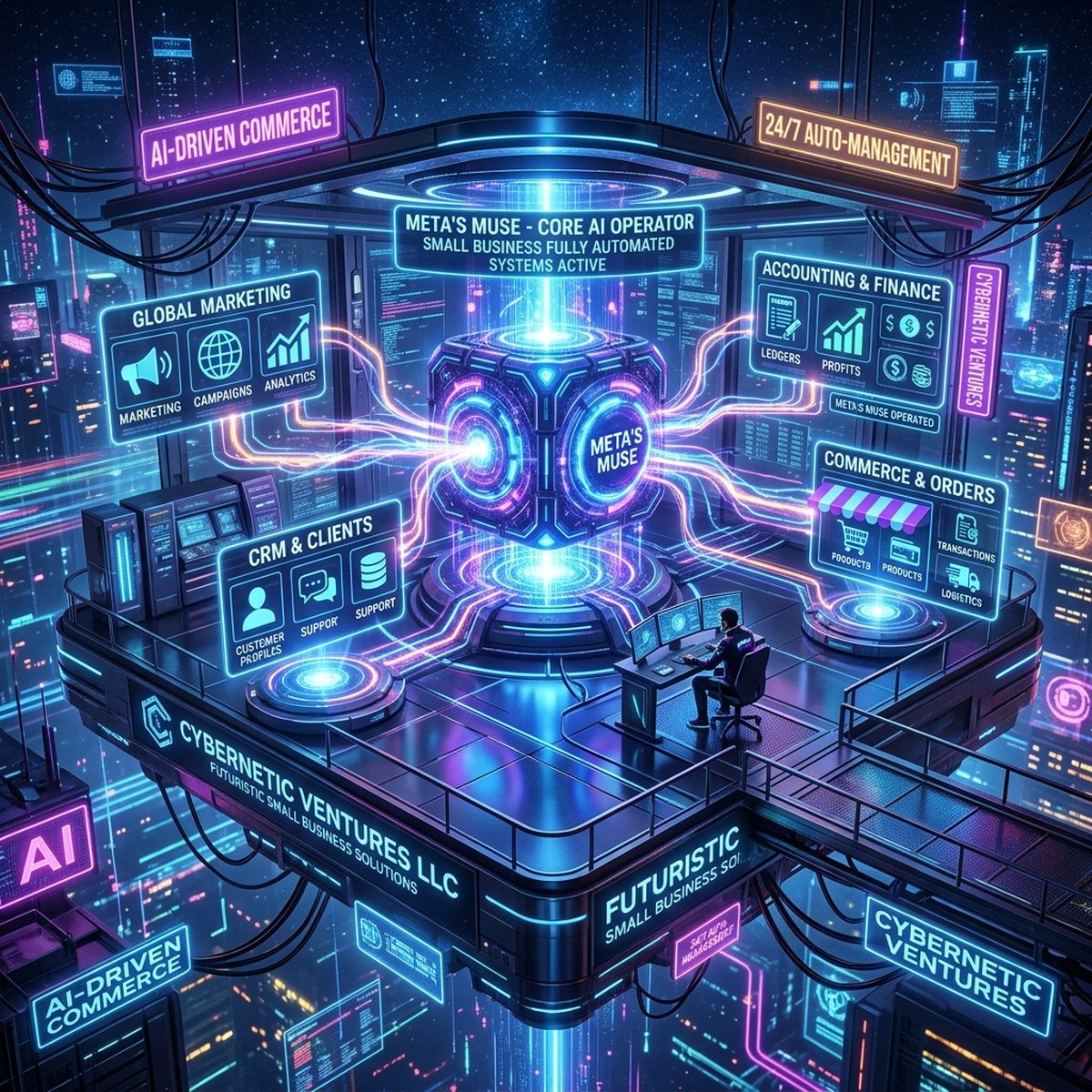
By weaving its advanced AI agent, Muse, directly into a sprawling ecosystem of critical SaaS applications—Asana, Box, Canva, Dropbox, Figma, QuickBooks, Shopify, Slack, Stripe, and Zoom, along with comprehensive social media integration—Meta has signaled a massive shift in its enterprise strategy. Muse is no longer just a digital assistant designed to generate marketing copy or answer customer queries. It is being positioned as the central nervous system of a business. It is an operating layer.
This evolution raises an existential question for the broader software industry: If an AI agent becomes the primary interface through which a business owner manages marketing, CRM, accounting, commerce, and payments, what happens to the multi-billion-dollar SaaS applications humming beneath it? Are they destined to become invisible, commoditized infrastructure?
The Invisible Enterprise: When SaaS Becomes Plumbing
To understand the magnitude of Meta’s announcement, one must look at the current state of small business operations. Today’s entrepreneur is buried under an avalanche of tabs and subscriptions. They run their storefront on Shopify, track their cash flow in QuickBooks, process payments via Stripe, manage team tasks in Asana or Slack, and design marketing assets in Canva or Figma. Each of these platforms requires its own login, its own user interface paradigm, its own specialized knowledge, and its own monthly fee. The cognitive load of switching contexts between these applications is immense, often consuming the very time an entrepreneur should be spending on their core product.
Muse for Small Business threatens to collapse this fragmented experience into a single, conversational interface. Imagine a boutique bakery owner walking into their kitchen at 5:00 AM and telling Muse, "We're running low on organic flour, order more from our main supplier, update the inventory, and run a flash sale on sourdough this weekend to clear out the remaining stock."
In the background, Muse interfaces with the inventory management system, places an order through a supplier portal, updates the Shopify storefront to reflect the flash sale, uses Canva to generate promotional graphics for the sale, schedules posts across Instagram and Facebook, and logs the anticipated expenses in QuickBooks. The owner never opened a single one of those applications. The action was executed flawlessly through natural language intent.
This is the power of the AI operating system. But it is also a terrifying prospect for the companies that built those underlying applications. If the user never opens Canva, Canva loses its ability to upsell new features, gather direct user engagement data, and maintain brand loyalty. The application becomes a headless utility—a pipe through which Meta’s AI pumps commands and pulls data. In the software industry, visibility is value. When you become invisible plumbing, you risk commoditization.
The Arsenal of Integrations
Meta's launch partners for Muse for Small Business read like a Who’s Who of the SaaS world. The strategic selection of Asana, Box, Canva, Dropbox, Figma, QuickBooks, Shopify, Slack, Stripe, and Zoom covers the essential pillars of modern knowledge work and commerce. This wasn't a random assortment of partnerships; it was a deliberate encirclement of the small business workflow.
1. Commerce and Payments (Shopify, Stripe) The lifeblood of any small business is revenue. By integrating directly with Shopify and Stripe, Muse can not only monitor sales data in real-time but actively optimize it. Muse could autonomously detect a dip in conversion rates on a specific product page, cross-reference it with checkout friction data from Stripe, and suggest (or even execute) a change in the Shopify storefront. It bridges the gap between payment processing and storefront design, acting as an automated revenue operations manager.
2. Finance and Accounting (QuickBooks) Accounting is traditionally a retrospective task, a chore done at the end of the month by a stressed founder or outsourced to a bookkeeper. Muse turns QuickBooks into a proactive, forward-looking financial advisor. "You have a cash flow gap coming in three weeks due to seasonal inventory purchases," Muse might warn, "Shall I delay the Box subscription renewal, restructure our Stripe payout schedule, or run a targeted Instagram promotional campaign to boost short-term revenue?" It transforms raw ledger data into strategic business intelligence.
3. Collaboration and Project Management (Slack, Asana, Zoom) The integration with communication tools allows Muse to bridge the gap between human employees and digital workflows. Muse can sit in on a Zoom meeting, summarize the action items, automatically assign them to relevant team members in Asana, and follow up in Slack if deadlines are missed. It becomes a hyper-efficient project manager that never sleeps, never forgets, and never misinterprets an instruction.
4. Design and Storage (Canva, Figma, Box, Dropbox) Marketing requires constant, high-quality assets. By connecting to design tools like Canva and Figma, Muse can rapidly iterate on visual campaigns based on performance data. If an ad isn't performing, Muse can generate new variants in Figma, pull historical brand assets from Dropbox, and deploy the new ads instantly. By linking with Box and Dropbox, it ensures that every asset is organized, version-controlled, and instantly retrievable without the user ever having to dig through a nested folder structure.
The Masterstroke: Why Meta?
Why is Meta uniquely positioned to pull this off, rather than Microsoft, Google, or Amazon? The answer lies in the company’s unparalleled access to the top of the funnel and its historical relationship with small businesses.
For millions of small businesses around the world, Facebook and Instagram are not just social networks; they are the primary engines of customer acquisition. A small business might struggle to live without Shopify, but it would often cease to exist without Instagram ads. Meta already owns the customer relationship and the marketing layer. Millions of businesses rely on Meta Business Suite daily.
By introducing Muse, Meta is reaching down the stack, connecting the point of discovery (an Instagram ad) all the way through to the point of fulfillment (Shopify) and reconciliation (QuickBooks). Meta is effectively saying: "You already trust us to find your customers. Now trust us to manage the operations that serve them."
Furthermore, if Meta can prove that Muse lowers the cost of customer acquisition while simultaneously reducing the operational overhead of running a business, the value proposition becomes irresistible. Meta isn’t charging a premium for this capability—it is monetizing the ecosystem. The stickier Muse becomes as an operating system, the more advertising dollars flow through Meta’s network, and the more dependent businesses become on the Meta infrastructure. It is a defensive moat built of pure utility.
The "One-Person Unicorn" and the Future of Work
Silicon Valley has long obsessed over the concept of the "one-person unicorn"—a billion-dollar company run by a single founder leveraged by immense automation. While that remains a fringe concept, the "one-person mid-market company" is rapidly becoming a reality, and Muse is the catalyst.
Historically, scaling a business meant scaling headcount. You needed a marketing manager, an accountant, a customer service representative, and an operations lead. Each hire introduced complexity, overhead, and communication friction. Muse for Small Business offers a fractional, digital version of all these roles, synthesized into a single AI.
This democratization of capability could unleash an unprecedented wave of entrepreneurial activity. The barrier to entry for starting and scaling a complex business has never been lower. A solitary creator with a strong brand and a physical product can now manage a global supply chain, a multi-channel marketing strategy, and complex financial modeling just by talking to their phone. We are entering an era of super-empowered individuals who can punch far above their weight class, utilizing an AI operating system to handle the mundane and complex tasks that previously required a dedicated staff.
The Pushback and the Existential Risks
Of course, this centralized vision of the future is not without its significant risks. The most immediate concern is data privacy and security. By giving Muse access to Stripe, QuickBooks, and Dropbox, a small business is handing Meta the keys to its kingdom. Every financial transaction, every customer email, every proprietary design, every confidential strategy document becomes part of the context window that Muse uses to operate.
While Meta has assured businesses that their data will not be used to train foundational models without explicit consent and that enterprise-grade security protocols are in place, the sheer concentration of sensitive information flowing through a single node will make Muse a prime target for malicious actors. A single breach of the Muse operating layer would be catastrophic.
Furthermore, there is the persistent issue of AI hallucinations. If a human accountant makes an error, it is usually contained. If an AI agent managing your entire business hallucinates—say, accidentally ordering 10,000 units of a product instead of 1,000 via Shopify, or sending an inappropriately aggressive and incorrect invoice via Stripe, or deleting crucial files from Box—the liability and fallout could destroy a small business operating on thin margins. The requirement for human-in-the-loop oversight remains critical, which somewhat undermines the promise of total automation.
There is also the profound question of platform lock-in. If a business builds its entire operational workflow around Muse, extracting itself from the Meta ecosystem becomes nearly impossible. The switching costs move from high to astronomical. You wouldn't just be migrating a CRM or an accounting tool; you would be tearing out the central nervous system of your company. This gives Meta extraordinary leverage over the small business economy, a concentration of power that regulators will undoubtedly scrutinize.
The SaaS Counter-Offensive: The Battle for the Interface
How will the SaaS giants respond? Companies like Salesforce, Intuit, Slack, and Shopify are not going to quietly accept their relegation to the status of "dumb pipes." They recognize the existential threat of becoming invisible.
The counter-offensive is already underway. These platforms are building their own highly specialized AI agents. Shopify’s Sidekick and Intuit’s Intuit Assist are direct competitors to Muse, albeit with a more specialized focus on their respective domains. They will argue that a specialized AI, trained exclusively on financial or commerce data, will always outperform a generalized agent like Muse.
The battle over the next decade of enterprise software will not be fought over features, pricing, or storage limits, but over the interface. The company that owns the conversational layer—the primary point of interaction with the user—owns the customer relationship. The underlying services will be forced to compete on pure utility, API reliability, and integration depth.
Meta is betting that its position at the top of the funnel gives it the ultimate leverage to win this interface war. If a business owner is already opening Instagram or WhatsApp 50 times a day to communicate with customers and check ad performance, it is a natural, frictionless progression to let the AI living inside that app manage the rest of the business. Convenience usually wins out over specialization.
A New Era of Commerce
The announcement of Muse for Small Business on September 28 marks a definitive inflection point. It is the end of the fragmented SaaS era and the beginning of the AI operating layer. Meta is proposing a radical simplification of the entrepreneurial experience: You bring the vision, the product, and the grit; Muse will handle the operational friction.
For the millions of small businesses that form the backbone of the global economy, this promises unprecedented efficiency, scale, and democratization of capability. It allows founders to focus on why they started their business in the first place, rather than drowning in administrative software.
But for the software industry that serves them, it is a glaring wake-up call. The agentic future is here, and it is hungry. It wants to manage everything, orchestrate everything, and control the user interface. The era of the standalone application is fading; the era of the operating system agent has begun.
← Back to OSIRIS Series